
Why Your Outdoor AC Unit Won’t Start After a Storm
The House Goes Quiet When The Storm Passes
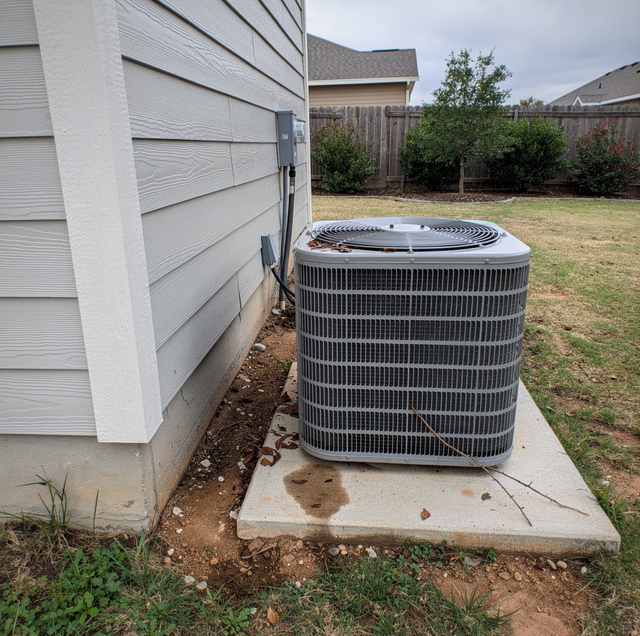
The wind dies down, the sky lightens, and you finally walk back inside after checking the yard for downed branches. You bump the thermostat down a couple of degrees out of habit, expecting the familiar click and hum from the side of the house. Nothing happens. The indoor blower might kick on and blow air through the vents, but the outdoor unit, the condenser sitting on its pad, stays completely silent. No fan spinning, no compressor hum, nothing.
That silence is unsettling, especially after a storm rattled windows and dropped hail on the roof for twenty minutes. Your first instinct is to wonder if the whole system just died. In most cases it hasn't. A no-start condenser after severe weather usually traces back to one of a handful of causes, and some of them are minor. Others are a warning sign that the equipment took real electrical damage. Knowing the difference matters because it determines what you can check on your own and what requires a trained technician with a meter in hand.
What A Storm Actually Does To Electrical Components
Lightning doesn't have to strike your house directly to cause trouble. A nearby strike, or even a surge riding in on the utility lines during heavy weather, can send a brief spike of voltage through your electrical system and into the outdoor unit. The two components most vulnerable to that spike are the capacitor and the control board.
The capacitor is a small cylindrical component that stores and releases a burst of electrical energy to help the compressor and fan motor start. Think of it like a tiny battery built for one job: giving the motor a hard shove the instant power is applied. A voltage spike can weaken or blow that capacitor in an instant, and once it fails, the motor may hum weakly and never actually spin, or it may not respond at all. Because a capacitor holds a charge even after the unit is switched off or unplugged, it is not something to open up or test by hand. That work belongs to a technician with the right tools and training.
The control board is the other frequent casualty. It manages the signal sequence between your thermostat and the outdoor equipment, and a surge can fry a circuit trace or a relay on that board without leaving any obvious outward sign. When the board is damaged, the unit may appear completely dead even though the breaker is fine and everything else looks normal.
Here's the part that often gets missed: storm damage rarely happens to equipment in perfect condition. A capacitor that has been quietly wearing down over several long, hot summers of heavy runtime is already closer to failure than a brand-new one. The storm's surge can be the final push on a part that was already worn thin, which is one reason two identical-looking storms can affect neighboring homes so differently. Age and prior stress on the equipment count for a lot.
Tripped Breakers And Disconnects Are A Simpler Story
Not every no-start after a storm points to a fried component. Storms bring power flickers, and a flicker or a brief outage can trip a breaker or knock loose a connection at the outdoor disconnect box, the small metal box mounted on the wall near the condenser. This is the good-news scenario, because a tripped breaker or a disconnect that has vibrated slightly out of position is something you can visually check yourself without any risk.
Lightning can also affect the whole home's electrical panel, tripping a breaker dedicated to the outdoor unit even though nothing inside the unit itself was harmed. If that's what happened, resetting the breaker restores normal operation, and the story ends there. If the breaker trips again immediately after you reset it, or trips repeatedly, that's a sign of a deeper electrical fault, and it means the breaker is doing its job by protecting the circuit from a real problem downstream.
Debris And Water Can Block A Restart Too
Storms move a lot of material through the air. Leaves, small branches, shingle grit, and mulch can pile up against the condenser's fan grille or get pulled into the cabinet, and heavy rain can leave standing water pooled around the base of the unit. In some cases, a unit with a safety float switch or moisture sensor will refuse to run specifically because it's detecting water where it shouldn't be, which is a protective feature rather than a failure.
A unit that's physically blocked, tilted, or partially buried in debris after high winds may also be sending a fault signal rather than actually being broken. Visual inspection from outside the cabinet, without removing panels, can usually tell you whether this is the case.
A Different Kind Of Weather Stress: Sudden Hard Freezes
It's worth drawing a clear line between storm damage and what happens during a sudden hard freeze, because homeowners sometimes lump every no-start problem into one category. A fast, deep drop in temperature is an entirely separate stressor with its own failure pattern. Extreme cold can affect refrigerant pressure, cause components to contract, and in some setups lead to ice formation on the coil if the system runs incorrectly during freezing conditions. That's a distinct mechanism from surge damage or wind-driven debris, and it typically shows up as icing or short-cycling rather than a completely silent unit. If your outdoor unit refuses to start during or right after a cold snap rather than a storm, the underlying issue and the fix are usually different, so it helps to mention the timing when you describe the problem to a technician.
What's Safe To Check Yourself
Before assuming the worst, there are a few things you can look at without opening the unit or touching anything electrical inside it:
- Check the thermostat display. Confirm it has power, is set to cool, and the set temperature is actually below the current room temperature.
- Look at your home's main electrical panel and see whether the breaker labeled for the outdoor AC or condenser has tripped. If it has, you can reset it once. If it trips again right away, stop and leave it off.
- Check the outdoor disconnect box near the condenser. Confirm the pull-out or switch is fully seated in the "on" position. If it looks loose or partially pulled, you can reseat it.
- Walk around the unit and look for obvious debris, standing water, or anything visibly leaning against the cabinet or blocking the fan grille from the outside.
- Note any smell, especially anything burnt or acrid, and mention it when you call for service. Do not attempt to inspect the source of that smell yourself.
None of this requires opening the condenser cabinet, removing any access panel, or touching wiring, terminals, or the capacitor. Those steps require the power to be fully isolated and the right test equipment, and they're where the actual risk lives.
When To Stop And Call A Technician
If the breaker resets fine and stays on, the disconnect is seated properly, and there's no visible debris or standing water, but the unit still won't start, that points toward internal electrical damage from the storm. This is exactly the territory of capacitors, blower motors, and control boards, and it needs a technician who can safely test for voltage, confirm the capacitor's charge has been properly discharged, and check the board for burnt traces or failed relays before touching anything further.
The same goes for a breaker that trips again as soon as you reset it, any burning smell, visible scorch marks near the disconnect, or a compressor that hums but never spins up. Each of those is a sign that something inside the electrical path needs a hands-on diagnosis, not a homeowner fix. Given that storm damage tends to hit equipment already worn down by years of heavy summer use the hardest, a technician's visit is also a chance to find out whether the problem is a single failed part or a system nearing the end of its usable life.
Frequently Asked Questions
Yes. Grid switching events, a downed line elsewhere on the utility network, or utility equipment faults during high winds can all push a comparable voltage spike into your home's wiring, so a unit can fail during a storm even when nobody in the neighborhood actually saw or heard a strike.
A surge protection device installed at the main electrical panel is designed to intercept spikes before they reach downstream equipment, including the outdoor condenser, and can reduce (though not fully eliminate) the odds of this type of failure during future storms.
The indoor air handler or furnace blower and the outdoor condenser operate on separate motors and, in many systems, separate circuits, so damage isolated to the outdoor unit's capacitor or board doesn't necessarily prevent the indoor blower from moving air, even though no actual cooling is happening.
Yes. Many systems include a built-in delay, sometimes called a time-delay or anti-short-cycle protection, that holds the compressor off for a few minutes after power is restored to prevent stress on the motor. If several minutes pass with no sound at all, that's different from a normal delay.
Hail impacts can bend the thin aluminum fins on the outdoor coil and, in some cases, jar internal wiring connections or the fan blade enough to affect operation, even when the exterior cabinet doesn't show heavy visible damage.
Repeated resets on a breaker that won't hold can generate extra heat and wear at the breaker's own contacts, a separate problem from whatever is happening inside the outdoor unit, which is why one reset attempt is the reasonable limit before leaving it alone for a technician.
Schedule a post-storm AC diagnostic — get your capacitor, control board, and breaker checked before a small storm issue turns into a bigger repair. Fix My Air DFW serves Fort Worth and the DFW metro. TACLA33709C. Call (817) 439-9811.
