
Cool but Clammy: Does Your Home Need a Whole-House Dehumidifier?
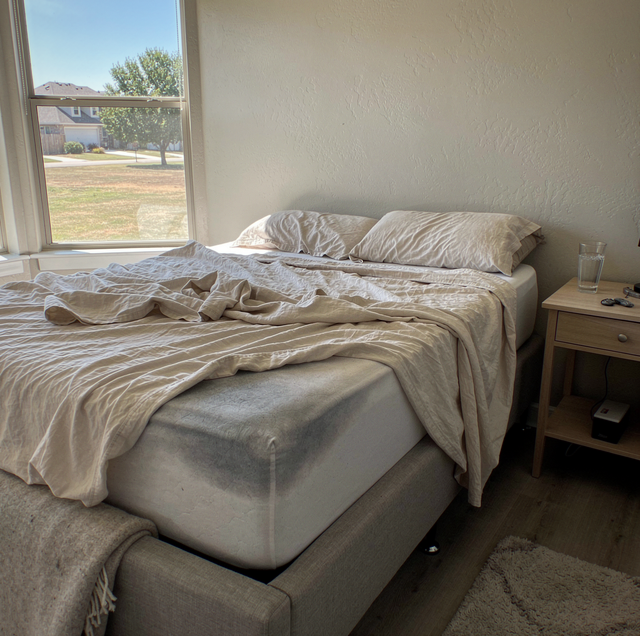
Your hallway thermostat reads 74, and the bedroom at the end of the hall reads 74 as well. The sheets feel faintly damp when you pull them back. The closet door has started catching in its frame, and the room carries a smell that is not strong, just present, the kind still air picks up when it sits on water. Nothing about your cooling system looks broken.
Whether your house needs a whole-house dehumidifier depends on when the moisture shows up. Your air conditioner does pull water out of the air, but only as a byproduct of removing heat, and only while the compressor is running. If the house gets damp when the thermostat has no reason to call for cooling, nothing you change about the air conditioner reaches it. If the house is damp while the system runs, the equipment is failing at the job it was built for, and a second machine is paying for it as a symptom.
Those two situations feel identical from inside the room. Cooling equipment answers two loads at once: sensible load, the heat a thermometer reads, and latent load, the energy carried in water vapor.
The House Is at Setpoint and Still Feels Wet
Damp air changes how a room reads before a meter confirms it. Your skin sheds heat partly by evaporating sweat, and evaporation slows as the air around you nears saturation, so 74 degrees at high humidity feels warmer and stickier than 74 degrees at low humidity while the thermometer refuses to move.
Wood reports it too. Trim, doors, and flooring sit at an equilibrium moisture content set by the surrounding air, typically 6 to 9 percent across the range a conditioned house occupies. Wood swells as that figure climbs. A door catching on its latch side is reading humidity for you.
You find condensation on the coldest indoor surfaces first: window glass, the bare metal of an uninsulated supply register, the outside of a toilet tank. Closed closets, a guest room nobody uses, and a bonus room over the garage get damp and musty ahead of the rest of the house because the air in them isn't being swept anywhere.
Drying the Air Is a Side Effect of Cooling It
Inside your indoor coil, refrigerant boils at a low temperature, and the fin surface sits around 40 degrees while the system runs. Air at 75 degrees and 55 percent relative humidity has a dew point near 58 degrees, so any surface colder than 58 degrees starts pulling water out of it. The coil is well under that, and moisture beads on the fins, runs into the drain pan, and leaves through the condensate line.
That water is the whole dehumidification story for a conventional cooling system. The coil is there to absorb heat, and the water comes out because the coil is cold enough to force it out along the way.
Removing it costs capacity. Condensing a pound of water vapor releases roughly 1,000 Btu; the coil has to absorb heat on top of the heat it takes from the air, which is why a cooling unit is rated for both total capacity and sensible capacity. The sensible-heat ratio, the ratio between them, ranges from 0.75 to 0.80 at design conditions for residential equipment.
None of it happens when the compressor is off. A blower moving air across a dry, room-temperature coil dries nothing. The dehumidification your house receives is metered out in compressor minutes, and nothing else buys it.
Short Run Times Cool the House and Leave the Water
A cooling cycle does not begin dehumidifying at minute one. The first several minutes go into chilling the coil's own metal mass and wetting the fins, and condensate has to build into a film thick enough to run before any of it reaches the pan. Shutdown hands part of it back, because water still clings to the fins when the compressor stops, and air moving across that wet surface evaporates some of it back into your house.
Airflow works on the same clock. The faster air crosses the coil, the less time each parcel spends against a cold surface and the warmer the fin surface runs. Blower settings are given in cubic feet per minute per ton, and 350 and 450 mark the ends of the usable range. At 450, less of the air passing through reaches the fin's surface temperature, so less of the water it carries leaves in the condensate.
Capacity produces the same result on every cycle. A system with more output than the house needs drives the room to setpoint quickly, shuts off, and repeats, so each run is short by construction, and the coil never reaches the part of the cycle where water leaves. Adding capacity to a house with a humidity complaint makes the complaint worse. Whether a particular system is oversized is a diagnosis in its own right, with several other causes of short cycles to clear first.
A two-stage or variable-capacity compressor works the other direction. It meets a partial load at partial output, which stretches run times for the same net cooling and keeps the coil wet and working longer.
Latent Load Can Arrive Without Any Cooling Load
Everything above assumes the two loads travel together, and on a hot afternoon they do. The case for a dehumidifier is built on the hours when moisture arrives, and heat does not.
Mild weather is the first case. Outdoor air in the 60s and low 70s carrying a heavy moisture content gives the house almost no sensible gain, so indoor temperature drifts nowhere near the setpoint, and the compressor never starts. No surface in the building is sitting below the dew point of the indoor air. Water that gets in stays in, and relative humidity climbs across days with nothing acting against it.
Ventilation is the second, and it belongs to tighter houses. When an envelope is sealed well enough that accidental air exchange no longer meets the fresh-air requirement, outdoor air is brought in deliberately through a duct or a fan, carrying whatever water vapor is outside onto the ventilation schedule rather than the cooling schedule. An energy recovery ventilator returns part of that moisture to the outgoing stream; a heat recovery ventilator transfers only heat.
The ground is the third. Soil under a crawlspace or beneath a slab holds water and releases it as vapor continuously, and vapor pressure drives it toward the drier side, which is the inside of your house. Exposed earth is covered with a vapor retarder for this reason. A vented crawlspace compounds it, since the vents admit outdoor air beneath a floor assembly that is cooler than the incoming air.
A whole-house dehumidifier answers this shape of problem. It is a self-contained refrigerant appliance with its own coil, compressor, and humidistat, installed near the air handler and either ducted into the return or given dedicated ducts. The difference is the control: it starts when its humidistat detects a rise in moisture, with no reference to what the thermostat wants, so it removes latent load without requiring sensible load. These units are rated in pints removed per day, and the rating needs its test conditions attached: 80 degrees and 60 percent relative humidity is the older test point, 73 degrees and 60 percent is the current test point for whole-home units, and a rating can be quoted at either. Ducted residential models run from roughly 70 to 130 pints at the warmer one.
What to Measure Before You Buy One
Start with whether your coil is getting the chance to work. A loaded filter or a fouled evaporator cuts airflow, and a coil starved of air can drop below freezing and ice over, at which point air stops passing through the fins, and dehumidification stops with it. Frost on the copper line at the outdoor unit or a dust-packed coil face belongs in that category.
With airflow cleared, the temperature split is what reaches the refrigerant side. Run your system steadily for 15 minutes, then read supply air at a register and return air at the grille with the same thermometer. The split a technician looks for on a properly charged system with correct airflow runs 16 to 22 degrees, and a reading well below that points at refrigerant charge or airflow. One wrinkle: a house carrying a heavy moisture load shows a smaller split even when everything works correctly, because more of the coil's capacity is going into water and less into temperature. The split reads the sensible half of the job, and a dehumidifier installed in front of an unresolved charge or airflow fault runs nearly continuously, leaving that fault where it was.
That reading covers one running minute, and drying is bought in minutes, so time a full cycle next, in mild weather rather than at peak load. Note how long the compressor runs before it satisfies. Cycles ending inside about 10 minutes are stopping before the coil has finished wetting.
A system that clears all three is pointing you outside itself, so go looking for the water. Confirm that your clothes dryer vents outdoors and its duct is intact, that bath fans terminate outside rather than into an attic, that a crawlspace has an unbroken ground cover, and that ventilation equipment is not running longer than the house needs.
Frequently Asked Questions
No, and it moves the thermometer the other way. A refrigerant dehumidifier releases the heat it strips from the water vapor, plus the heat from its compressor motor, back into the same airstream it just dried, so the air leaving it is drier and several degrees warmer than the air that went in. Drier air feels cooler on your skin even though the thermostat reading goes up.
It goes near the air handler, in a mechanical closet, attic, or basement, tied into the return duct or given its own supply and return. It needs a condensate drain, or a small pump where gravity will not carry the water, plus its own electrical circuit. Wiring it to start the air handler blower is what carries the dried air through the house instead of letting it pool near the unit.
Indoor relative humidity between 30 and 50 percent keeps mold in check, and 50 is a workable setting for a house with a cooling season. Two details matter more than the number itself. A humidistat cycles across a band a few points wide rather than holding one value, and one mounted inside the return duct reads blended air from the whole house rather than the room that feels worst.
A room with a supply register and no return path pressurizes as soon as its door closes. The air pushed in has to go somewhere, so it exits through gaps in the ceiling plane and exterior walls, and replacement air is drawn in from wherever the envelope is leakiest. Undercutting the door by about an inch, or adding a transfer grille, lets that room breathe back toward the return.
A vented crawlspace sits outside the conditioned envelope, so a unit serving the living space has no path to control it. Encapsulation is the route that reaches it: seal the vents, cover the ground and pier walls with a sealed liner, then either supply a small amount of conditioned air or add a dedicated unit. A slab-on-grade house has no crawlspace, though vapor still moves up through concrete unless a retarder went under the pour.
Take two relative humidity readings in one central room with the same meter: one after the system has cooled steadily for 30 minutes, one on a mild day after it has sat idle for an hour. Above 60 percent while running says your coil is not doing its work. Near 50 while running, past 60 while idle, says the equipment is fine, and the house gains water on its own schedule.
Sorting a control problem from a genuine moisture load takes a technician with a meter and a set of gauges — the readings decide whether new equipment is the answer at all. Fix My Air DFW serves Fort Worth and the DFW metro. TACLA33709C. Call (817) 439-9811.
