
What’s Causing Water To Pool Around Your Indoor AC Unit
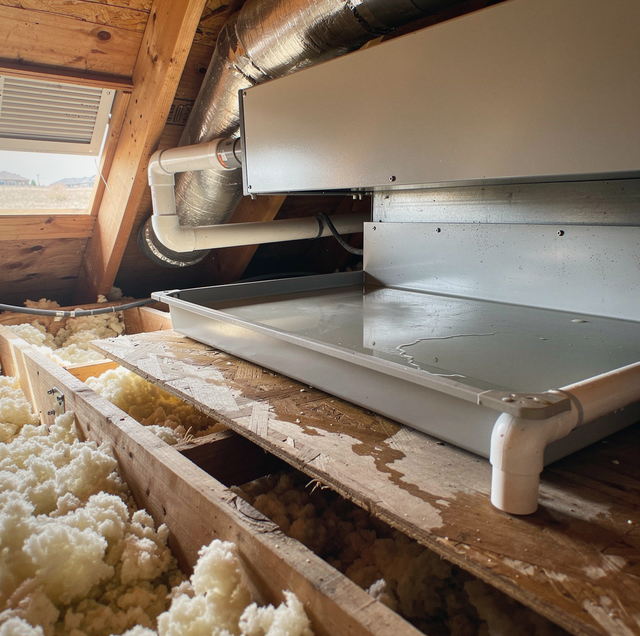
You open the closet door to grab something and step in a puddle you didn't leave there. Or you're in the attic swapping out a filter and notice the plywood under the air handler has gone soft and dark. Water pooling around an indoor AC unit is one of those problems that looks the same from the outside no matter what's actually wrong underneath it, which is exactly why it gets misdiagnosed so often. The unit that cools your home also produces a steady stream of water as part of its normal operation, and that water is supposed to leave the house through a dedicated path. When it doesn't, it shows up on your floor instead. Figuring out which of five common failure points is responsible starts with looking closely at where the water is coming from and when it appears.
A Clogged Condensate Drain Line Traps Water At The Source
As warm, humid air passes over the evaporator coil inside your air handler, moisture condenses on the coil's surface, just as it beads up on a cold glass on a humid afternoon. That water drips into a shallow pan underneath the coil, then flows out through a PVC drain line, usually to the outside of the house or into a floor drain. Left alone in that dark, damp, low-airflow environment, the inside of the line becomes an easy place for algae, mold, and fine dust to grow into a sludge that narrows the pipe over months of runtime.
Once the clog closes off the line, condensate continues to arrive at the pan but has nowhere to go. The pan fills, then overflows over its edge, and the water shows up as a puddle directly under or near the indoor unit. A clogged line is usually the first cause worth ruling out because it's also the easiest to check yourself. With the system powered off, you can safely look at the pan and the visible run of the line for anything obvious. To check whether the line itself is actually blocked, though, the system needs to be running: turn the cooling on and let it run for fifteen minutes or more, ideally on a humid day when condensate production is highest, then look at the end of the drain line where it exits the house or terminates indoors. If you don't see any dripping or moisture there despite an active puddle inside, the line is likely blocked somewhere between the pan and the outlet. A faint, musty smell near the unit often accompanies this cause, since it's the same buildup that eventually restricts the flow.
A Cracked Or Corroded Drain Pan Lets Water Escape Even When The Line Runs Clear
The drain pan itself is a wear item, not a permanent fixture. Metal pans corrode over years of sitting in a wet environment, and plastic pans can crack from age, a stray bump during a filter change, or the weight of anything set on top of the unit. Biological sludge and airborne dust that settle into the pan over time can also build up along its seams and edges. As that grime holds moisture against the metal, it accelerates corrosion and can open small gaps that weren't there when the pan was new.
What separates this cause from a clogged line is timing and location. If water is pooling even though the drain line is clearly flowing at its outlet while the system is running, or if you can see rust spots, a crust of dried sludge, or a visible hairline crack along the pan's edge, the pan itself is likely the source rather than anything downstream of it. This failure tends to show up gradually, with a small damp spot that gets a little larger every week rather than a sudden flood.
A Frozen Evaporator Coil Floods The Pan Once It Thaws
Sometimes the water problem isn't about drainage at all until after the fact. If airflow across the evaporator coil gets restricted, whether from a dirty filter, closed supply vents, or a struggling blower motor, or if the refrigerant charge runs low, the coil can drop below freezing instead of just chilling the air passing over it. Moisture in that airflow then freezes onto the coil's surface as ice rather than draining away as liquid. Over hours of run time, that ice sheet can spread across the coil and even coat the nearby refrigerant lines.
The house often feels warmer than the thermostat setting during this stretch because a coil buried in ice can't transfer heat as well as a clean one, and airflow from the vents may feel weak. The pooling shows up later, once the system shuts off or gets switched off manually, and that entire buildup of ice melts at once. A pan and drain line sized for a steady trickle of condensate isn't built to handle that volume all at once, so the water overflows onto the floor or ceiling below. Frost or ice on the coil or line set while the system is running is the clearest sign this is what's happening. The cause of the freeze-up, whether it's airflow- or refrigerant-related, isn't something to chase down on your own, since a low refrigerant charge points to a sealed system that only a licensed technician should open and service.
If you see ice on the coil or refrigerant lines, turn the system off at the thermostat and let it thaw fully before running it again. Don't attempt to check refrigerant levels or touch the lines yourself; that's a job for a licensed technician.
A Disconnected Or Poorly Pitched Drain Line Sends Water To The Wrong Place
A condensate line only works if it has an unbroken, downhill path from the pan to its exit point. PVC joints along that run can loosen over time from vibration, or come apart entirely if something bumps the line during an attic repair or a pest gets into the space. Separately, if the line was installed without enough slope, or if it sags in the middle from age or from resting on insulation, water can sit in that low spot instead of continuing to flow out, eventually backing up toward the pan.
This cause looks different from a simple clog because the water often doesn't appear right at the unit. Instead, trace the visible run of the drain line with a flashlight, especially through an attic or a closet ceiling, and look for damp insulation, a stained joint, or a section of pipe that visibly sags below the level of the pan. If you find moisture along the line's path rather than only underneath the unit itself, a disconnected fitting or a bad pitch is a more likely explanation than a clog inside the pipe.
A Tripped Float Switch Or Clogged Secondary Drain Points To A Bigger Backup
Many indoor units include a backup system specifically to catch condensate before it causes real damage. A secondary (or safety) pan often sits underneath the entire air handler, separate from the primary pan under the coil, with its own drain line that's sometimes routed to a visible spot like above a window so a rising water level gets noticed early. A float switch, a small sensor that sits in the primary pan or drain line, is designed to shut the whole system down automatically the moment water rises to a level that suggests a clog or overflow downstream.
If you find standing water in that secondary pan, or notice the system won't turn on at all, the switch has likely already done its job and shut the unit down to prevent a larger flood. That's a good outcome in one sense, since it stopped the leak from getting worse, but it also confirms there's a clog or drainage failure further up the chain that still needs to be found and cleared. On the other hand, if the float switch itself gets coated in the same sludge that clogs drain lines, it can stick in place and fail to trip when it should, allowing an overflow to continue unnoticed until it causes real damage to the flooring or drywall below.
A technician can confirm a float switch is working by testing whether it interrupts the circuit when lifted, which is a check worth leaving to them rather than reaching into a live air handler yourself. With the system powered off, you can safely clear visible debris around the switch per the manufacturer's instructions. If the system still won't restart afterward, treat that as a sign something upstream needs a closer look rather than resetting it repeatedly.
How To Narrow Down Which Cause Is Yours
Start with the system powered off at the thermostat, both to prevent further water from being added to the problem and to give you a safe moment to look around. With the system off, look at the pan itself for cracks or corrosion, glance at the coil area for any sign of frost or ice, trace the visible portion of the drain line for sagging or disconnected joints, and check whether a secondary pan or float switch shows standing water or has already shut the system down. Then, to check the drain line's exit point for actual flow, switch the system back on in cooling mode and let it run for fifteen minutes or more, ideally on a humid day, before checking whether water is dripping from the outlet.
Each of those checks points toward one of the five causes above, and taken together, they usually narrow the list down to one or two likely culprits before a technician ever arrives. A clogged line without much frost or corrosion points toward a routine drain clearing. Standing water at the unit while the drain line runs freely at its outlet points toward the pan. Frost on the coil points toward an airflow or refrigerant issue that needs a professional diagnostic rather than a homeowner fix. And water tracking along the length of the line itself, rather than pooling right at the unit, usually means a joint or a pitch problem somewhere between the pan and the outlet.
Frequently Asked Questions
Most technicians recommend clearing a condensate line at least once a year, typically at the start of cooling season before runtime picks up. Homes with heavy nearby tree cover, higher humidity, or a system that runs nearly nonstop through a long DFW summer may benefit from a mid-season check, too, since the algae and sludge that narrow the line build up faster the more the system runs.
Yes. Water that sits under an air handler for even a few days can soak into subfloor material, drywall, or ceiling joists if the unit is in an attic, and standing moisture in an enclosed closet or attic space creates conditions where mold can start growing in surrounding building materials, not just inside the unit itself.
No. Sweating on metal ductwork or a vent cover usually indicates missing, damaged, or poorly sealed insulation around that section of duct, which allows warm, humid air to contact a cold surface. That's a separate issue from condensate drainage at the indoor unit itself, even though both involve moisture forming where it shouldn't.
A drain line that's been sitting unused can develop a partial clog from settled sediment that a slow, steady drip doesn't dislodge. When the system kicks on after a period of downtime, particularly at the start of a new cooling season, the sudden condensate flow can be enough to reveal a restriction that wasn't obvious before, even if the line seemed to drain fine on a quick visual check.
Yes. High-efficiency condensing furnaces extract enough heat from the combustion gases to produce their own condensate, which is drained through a separate line and often via a small internal pump. That drain path can clog or fail independently of the air conditioning system's condensate line, even though both may exit near the same indoor unit.
The underlying cause is similar: a mini-split's indoor unit also collects condensate off its coil, but many mini-splits rely on a small condensate pump rather than gravity alone to move that water to a drain. If that pump fails or its float sensor sticks, water can back up and drip from the unit itself rather than pooling on a closet or attic floor, as a central system's overflow typically does.
Schedule a condensate and drain system inspection — get the water pooling around your indoor AC unit traced to its source and fixed the same day when possible. Fix My Air DFW serves Fort Worth and the DFW metro. TACLA33709C. Call (817) 439-9811.
