
Commercial Rooftop Unit Signs to Catch Before Peak Season
A light-commercial rooftop unit does two jobs from one cabinet above your ceiling. During a cooling peak, its compressor, condenser fan, and supply blower run for long stretches against the heat your occupants and equipment add. Through a heating peak, the same blower carries air across a gas heat section that has to light, prove flame, and shut down safely on every call.
Wear from one peak rarely waits for the next. It surfaces inside your space first: a zone that never catches up, a new sound through your diffusers, water where your ceiling should be dry. You seldom see the unit, so you work from those clues, and catching them between peaks gives your technician time to fix the cause before your busiest week.
What Strains a Rooftop Unit Through a Cooling and a Heating Peak?
Cooling runtime loads the refrigeration side. The compressor starts and stops many times a day, the condenser fan pulls outdoor air through a coil that collects dust, leaves, and seed fluff, and the evaporator coil pulls moisture out of the supply air, which then has to drain from the cabinet. A coil that loads up with debris makes the compressor run longer for the same result, and a motor or capacitor nearing the end of its life is more likely to fail during a heavy-load start than a mild one.
Heating runtime loads a different group of parts. Those parts sit idle for months and then cycle over and over during a cold stretch, so something that weakened quietly over the off-season often shows up on the first morning the building truly needs heat. A heat section that locks out that morning leaves every zone the unit serves without heat.
The months between the peaks carry their own load. The cabinet sits outdoors through wind, hail, and sun, and on many units an economizer moves a damper to bring in outdoor air when conditions allow. A problem that starts in spring or fall can stay hidden until demand climbs again.
Comfort Complaints That Show Up Before the Unit Quits
The earliest sign is usually a person noticing something, well before a part stops outright. Watch for patterns more than for single complaints.
A zone that falls behind at the same time every day: The unit runs, but the supply air never gets cold enough, or warm enough, to catch up. That pattern points toward coil and airflow problems, a struggling compressor or motor, or a refrigerant charge issue.
Air that feels stuffy or clammy after the setpoint is reached: On units with an economizer, a damper that is stuck or badly controlled changes how much outdoor air comes in. Operations and maintenance guidance on air-side economizers notes that improper control can supply excessive outdoor air when conditions are unfavorable, increasing energy use in both hot and cold conditions.
Heat that arrives late or not at all: Warm-up takes longer each morning, or the blower moves cool air even when heat is called for. That usually traces to the gas heat section, its igniter, or a safety lockout.
Thermostats that staff keep adjusting: When people raise and lower setpoints to force a response, the original fault gets buried under extra cycles. Ask your team to report the complaint and leave the setting alone.
Noises, Smells and Vibration Coming Through the Ceiling
A rooftop unit sits directly on the building structure, so its sounds travel down through the deck and out the supply diffusers. A high squeal at startup that fades within a minute or two usually points to a slipping belt on a belt-drive blower. A new grinding, rattling or thumping that follows the fan points to a bearing, a loose blower wheel or a panel that has worked free. A hard buzz or repeated clicking without the unit starting can indicate a failing capacitor, contactor, or control fault. Note whether a noise comes at startup, during steady running or at shutdown, and whether it follows cooling or heating, because that detail narrows the fault before anyone opens a panel.
Smell is a separate channel. A dusty, burnt odor the first time the heat runs after months off is common and fades after a short run. An odor like hot plastic or electrical insulation that lingers needs a technician the same day. If anyone smells gas in the space or near the roof hatch, get people out of the area and call the gas utility from outside.
Every one of these faults sits behind the unit's access panels, beside spinning fan blades, a belt drive, live electrical parts and, on gas-heat units, the heat section. Opening those panels is work for an HVAC technician who shuts off and locks out power first, never for staff with a screwdriver and a flashlight.
Water Where the Ceiling Should Be Dry
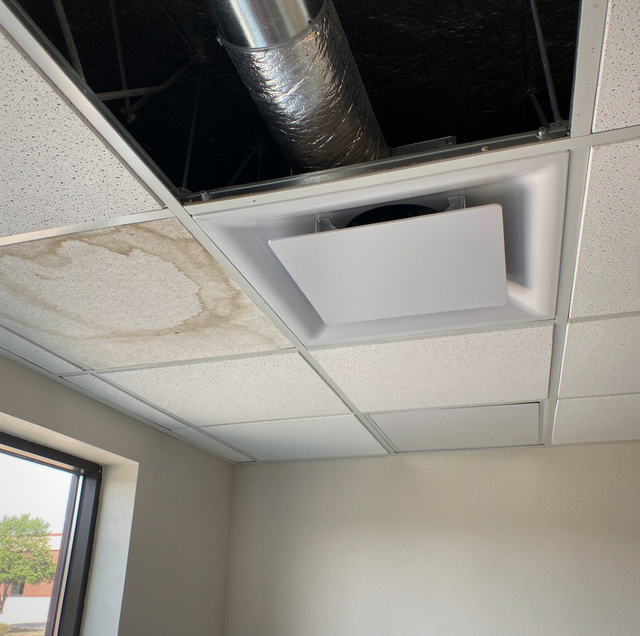
Every hour of cooling pulls water out of the air, and on a rooftop unit that water has to leave the cabinet through a drain pan and trap before it runs off the roof. Engineering guidance on air traps for packaged rooftop unit drains notes that a clogged condensate drainpipe can leave standing water inside the unit and cause leaks into surrounding areas, such as a drop ceiling, increasing the risk of mold and bacterial growth.
Inside the building, that shows up as a stained or sagging ceiling tile, drips from a diffuser, or water on the floor below the unit, often after a long cooling run. A stain under the unit can come from the cabinet, the drain line, or the roof around the curb, so the first visit needs to establish whether water is leaving the unit or entering through the roof. Timing helps separate the two. Water that appears during long cooling runs and stops within hours of the unit shutting off leans toward the unit, while water that follows rain with the unit idle leans toward the roof. A technician handles the pan, trap and drain; a roofer handles the membrane.
Keep people away from a wet ceiling near light fixtures or ceiling-mounted equipment, and call for service instead of pushing a tile up to look.
Short Cycles, Lockouts and Tripped Breakers
Controls give their own warnings. A unit that starts, runs a few minutes, stops and starts again is short cycling, and the list of possible causes is long: a thermostat placed where it warms or cools faster than the room, a safety switch opening on refrigerant pressure, a dirty coil, or a failing compressor, motor or capacitor. Short cycling also wears those same parts faster, so it deserves a visit even when the space still feels comfortable.
A breaker that trips for the rooftop unit should stay off until a technician finds out why. Resetting it repeatedly pushes the same fault back through the compressor and wiring.
Runtimes that keep getting longer while cooling gets weaker can point to a refrigerant leak. Finding the leak, repairing it, and correcting the charge is sealed-system work for a technician, and adding refrigerant to a leaking unit only postpones the same complaint.
On the heating side, a gas heat section that tries to light, fails, and stops trying has usually gone into a safety lockout. That lockout protects the building. Clearing it without finding the cause removes the protection, which is why combustion and venting checks belong in the repair.
A Walk-Through Table of Signs and Where They Point
Use this table on a walk-through of the building, not on the roof. Each row pairs something you can notice from the floor with the repair it most often leads to.
| Sign you notice | Where it tends to show up | Repair it usually points to |
|---|---|---|
| One zone warm or cold at the same time each day | The same rooms, the same hours | Coil and airflow checks; compressor, motor, or refrigerant charge |
| Stuffy or clammy air with the setpoint reached | Meeting rooms, dining rooms, crowded spaces | Economizer and control problems; thermostat and zoning faults |
| Cool air blowing on a call for heat | Every zone the unit serves | Gas heat-section and igniter faults; safety lockouts |
| Squeal, grinding or new vibration | Ceiling and diffusers below the unit | Belt, motor and electrical service; blower and airflow problems |
| Stained, sagging or dripping ceiling tile | Directly under or near the unit | Condensate and drainage issues, or the roof, confirmed on site |
| Unit starting and stopping every few minutes | Run sounds, thermostat display | Thermostat faults; compressor, motor and capacitor failures |
| Warm-up taking longer each morning | Spaces that open earliest | Gas heat-section faults; blower and airflow problems |
| Breaker tripping for the unit | Electrical room | Compressor, motor and electrical faults |
| Lingering hot-plastic or electrical odor | Supply air from the diffusers | Same-day visit; control-board and wiring repairs |
No single row is a diagnosis. A warm zone paired with a squeal points somewhere different from a warm zone paired with a wet tile, so two signs noticed together give a technician a real head start.
Checks That Stay on the Floor
A few useful checks need no ladder. Confirm the thermostat schedule still matches your operating hours, since a schedule lost after a power outage can look like a failing unit. Walk the space for supply diffusers and return grilles blocked by shelving, stock, or hanging signage. Look for ceiling tiles that have changed color since you last walked through.
Do not climb a roof ladder, open a roof hatch, or cross the roof near skylights and edges to look at the unit, because a fall can be fatal; an HVAC technician working with roof-access fall protection makes that trip.
Filters, belts, coils and the drain trap all live inside the rooftop cabinet, so their condition is a technician finding.
The Reading a Technician Takes on the Roof First
Before anyone resets anything, the unit's current state is evidence. For units whose controller stores alarms or lockouts, the technician records the fault history and whatever the display shows upon arrival, since a power cycle can clear some of it. With the unit running, the next measurement compares the air entering the unit with the air leaving it, which separates a unit that runs but moves little heat from one that has stopped working. If the unit has more than one stage of cooling or heat, the technician also confirms each stage comes on, since a unit limping along on one stage can pass for one that is simply too small. You help most by leaving the controls and the breaker exactly as the fault left them instead of cycling power before the visit.
Frequently Asked Questions
It can. Hood fans push a large volume of air out of your restaurant, and that air has to be replaced. When make-up air falls short, your entry doors pull hard, unconditioned air leaks in around them, and your dining room stays uncomfortable while your rooftop unit takes the blame.
New walls can cut a room off from its supply or return air. A thermostat moved during construction can end up beside a window, a printer, or a server closet, so it responds to that heat and not to the room. If you have remodeled since your last service visit, show the technician which walls and zones changed, because your original duct layout may no longer match your floor plan.
A trap holds a column of water tall enough to resist the pressure your blower creates. Engineering guidance on these traps notes a trap not tall enough to hold condensate for months will likely dry out during winter and the shoulder seasons and leak air. You would never spot that, so you rely on your technician to check it.
Note the time of each complaint, which zone and thermostat it involved, what the display showed, and whether you could hear the unit running. Add the outdoor conditions if you know them. List any other trade that worked on your roof recently, such as roofers, electricians or sign installers, since their work can disturb panels, wiring or drain lines.
Yes, because the two modes lean on different parts. Cooling depends on the compressor, refrigerant circuit and condenser fan; gas heat depends on the inducer motor, igniter, flame sensing and venting. A clean run in one mode proves little about the other, so you can ask your technician for a test run of the idle mode before you need it.
Yes, even if it is still running. Hail can flatten the thin aluminum fins on a condenser coil, reducing airflow and making the compressor work harder to provide the same cooling. Wind can loosen an access panel, letting rain reach the electrical compartment, and it can drop branches or debris into the condenser fan. None of that is visible from your parking lot, and your unit may seem fine until the next heavy demand day. Afterward, watch for new noises, water at your ceiling or a zone that falls behind, and have the cabinet inspected before your next peak.
Schedule a rooftop unit inspection before your next cooling or heating peak — a technician goes up with fall protection, checks the controls and cabinet, and ties each sign your staff noticed to the exact repair it needs. Fix My Air DFW serves Fort Worth and the DFW metro. TACLA33709C. Call (817) 439-9811.
