
Should I Repair or Replace a Hail-Damaged AC Condenser?
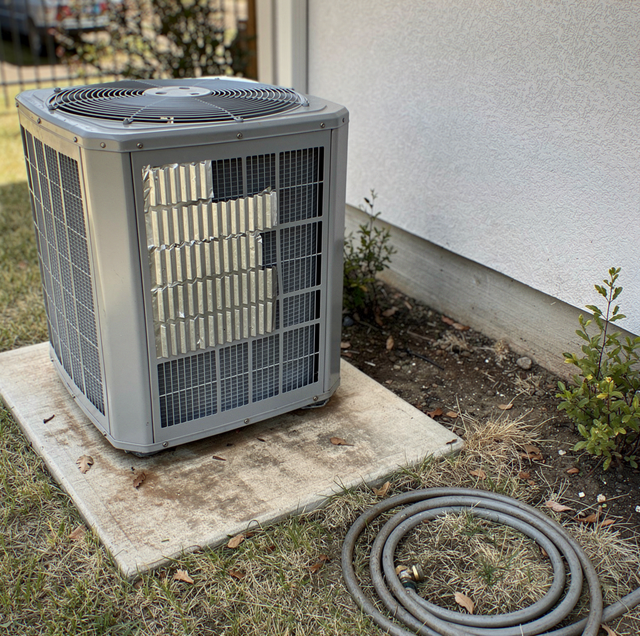
The hail passes, and you walk out to find the outdoor half of your air conditioner looking like it went ten rounds, the casing dented and the delicate metal fins flattened and mashed on the side that faced the storm. It still runs, but you are left wondering whether those bent fins are a cosmetic annoyance or a real problem, and whether you are looking at a comb-out or a whole new unit.
The answer depends on how deep the damage goes, and there is a clear line between the two. Knowing where that line falls keeps you from replacing a unit that could be repaired or nursing one that is actually finished.
Why Bent Fins Matter at All
The outdoor unit, the condenser, sheds the heat your system pulls out of the house through a coil wrapped in hundreds of thin aluminum fins. Air has to pass freely through those fins to carry the heat away. When hail flattens them, it blocks airflow, and the system has to work harder and run less efficiently to move the same amount of heat. So bent fins are not just cosmetic: enough of them restrict airflow, raise energy use, and make the compressor work harder. But, and this is the key, bent fins are also one of the more repairable kinds of hail damage.
When It Can Be Repaired
The most common fix for hail-flattened fins is direct: a technician combs them back into shape with a fin-combing tool, straightening the aluminum to reopen the airflow paths. When the damage is limited to bent fins and the coil itself is intact, this restores most of the lost airflow without requiring any parts to be replaced. Light to moderate fin damage, where the fins are bent but not torn and the coil underneath is undamaged, is squarely repair territory. The casing may look rough, but if the guts still work, combing the fins and straightening the cabinet often brings the unit back to health.
When Replacement Is the Real Answer
Replacement moves onto the table when the damage goes past the fins into the coil and the sealed system. If the fins are torn rather than just bent, if the coil is punctured and leaking refrigerant, or if so much of the fin surface is crushed that combing cannot restore adequate airflow, the unit is no longer a simple repair. As a rough guide, damage is considered serious when fins are bent deeply or a large share of the surface, roughly a third or more, is crushed, and it is more serious still if the refrigerant pressure has been affected. A leaking or structurally damaged coil is often not worth repairing, and replacing the condenser becomes the sound call.
| Lean toward repair when… | Lean toward replacement when… |
|---|---|
| Fins are bent but not torn | Fins are torn or shredded |
| The coil is intact, no leak | The coil is punctured or leaking refrigerant |
| A minority of fins are affected | Roughly a third or more is crushed |
| System holds pressure and cools | Refrigerant pressure is clearly off |
Don't Forget the Insurance Angle
One practical point specific to hail: damage to an outdoor AC unit is frequently covered under a homeowner's policy, the same as other hail damage to the property. Before you decide anything, it is worth documenting the damage with photos and checking your coverage, because that can change the math on repair versus replacement. A technician's assessment of whether the fins can be combed or the coil is compromised is exactly the kind of documentation an adjuster looks for. Sorting the coverage and the diagnosis together, rather than rushing one before the other, tends to lead to a better outcome.
What Happens If You Just Leave It
It is tempting to ignore flattened fins because the unit still cools, but restricted airflow quietly costs you. The system runs longer to shed the same heat, which increases energy use during the hottest months, and the compressor, the most expensive part to replace, works harder and wears out faster under the back pressure. Bent fins also trap debris and hold moisture against the coil, which can speed corrosion over time. None of that shows up as a dramatic failure, so it is easy to put off, but a simple comb-out can turn into a compressor strain that shows up on the power bill and in the unit's lifespan.
Frequently Asked Questions
Severity is about coverage, not the dented look. Fins shed heat by letting air through the coil, so scattered bends across a small patch barely move performance, while a broad flattened zone on the storm-facing side chokes airflow enough to raise head pressure and make the compressor labor. A fin comb has to match the fin spacing, typically in the 12- to 20-fins-per-inch range, and it can only reshape bent aluminum, not aluminum that is folded flat, creased, or torn. A tech can usually recover fins that are leaning or partly closed, but fins mashed edge-to-edge or packed into the coil often will not reopen cleanly, and pushing a comb too hard there just tears them. That threshold, roughly how much of the face is combable versus crushed, is the practical line between a comb-out and a coil call.
The cabinet sheet metal and the coil are two different things, and only one of them holds refrigerant. A dent or crease in the outer casing or protective guard is cosmetic: it looks bad but does not affect the sealed system. The damage that matters occurs when hail strikes the coil tubing woven behind the fins, because that thin copper or aluminum is what carries the refrigerant, and a puncture or split there causes a leak. Two telltale ofsigns to a coil leak rather than a cosmetic hit are an oily film or residue around the flattened area, since escaping refrigerant carries a trace of compressor oil that streaks the fins, and a system that suddenly cools poorly or ices up because it is losing charge. A tech confirms it using a leak detector or by comparing system pressures to the charge. Bent fins over an intact coil comb out; a coil that streaks oil or fails a pressure check does not, and that is the split between a repair and a replacement.
Replacement moves onto the table once the damage is in the sealed system rather than the fins. The clearest case is a punctured or leaking coil: a full outdoor coil is a large, labor-heavy part, and on many units, its condition drives the whole repair-or-replace math. There is a second, less obvious failure mode: if hail-choked airflow was ignored long enough, the compressor may already have run hot against high head pressure, and a compressor that has overheated or is drawing high amps and short-cycling can be near the end even after the fins are combed. Watch for a unit that trips its breaker, hums without starting, or cools weakly after a comb-out, all signs the compressor took a hit. When the coil leaks or the compressor is failing, you are into the two most expensive components in the box, and replacing the condenser is usually the sounder long-term call than chasing each part.
Yes, more than people expect, because the outdoor condenser and the indoor evaporator coil are engineered to run as a matched pair. Swap in a new condenser, especially a higher-efficiency one, over an old indoor coil and metering device that were built for a different capacity, and the mismatched set can lose the efficiency you paid for, cool unevenly, and in some cases risk warranty coverage that requires a rated matched combination. Efficiency ratings are published for the pair, not the outdoor box alone, so a high-rated condenser bolted to an undersized or older indoor coil will not deliver its rated number. If a hail claim forces a condenser replacement, ask whether the existing indoor coil and refrigerant type match it; older systems on a phased-out refrigerant often push you toward replacing both sides, so the new equipment actually performs and stays under warranty.
Yes. A unit can keep cooling while running less efficiently and straining the compressor because of restricted airflow, and coil or refrigerant damage is not always obvious from the outside. Having it inspected after a hailstorm confirms whether it is a simple fin comb-out or something deeper, and it catches problems before they shorten the system's life.
You cannot stop hail, but you can reduce exposure. Purpose-made hail guards or a protective cover designed for airflow can help, and positioning or shielding the unit where practical reduces direct strikes. Never cover the unit with something that blocks airflow while it is running. After any significant storm, a quick look and an inspection can catch damage early.
Match the Fix to How Deep the Damage Goes
A hail-battered condenser is not automatically a replacement. If the fins are bent but the coil is intact, combing them straight usually restores the unit, and that covers a lot of storm damage. When the damage tears the fins, punctures the coil, or throws off the refrigerant pressure, replacement is the honest answer. Get it assessed, document it for insurance, and let the depth of the damage, not just the dented look, decide the call.
If hail left your outdoor unit dented and the fins flattened, an assessment will tell you whether it needs a comb-out or a replacement. Fix My Air DFW serves Fort Worth and the DFW metro. TACLA33709C. Call (817) 439-9811.
