
What Causes an AC Capacitor to Fail, and How to Spot It
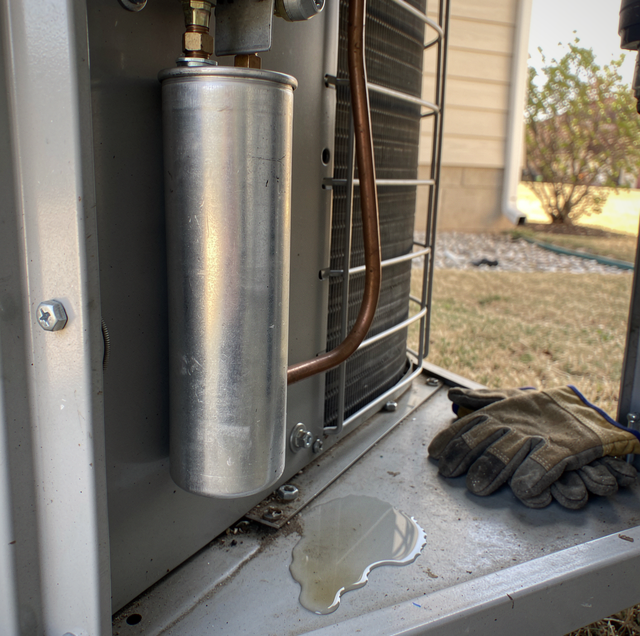
For a part the size of a soda can, the capacitor punches far above its weight. It sits inside your outdoor unit and does one blunt, thankless job: it stores up a jolt of electricity and hands it over the instant a motor needs to turn. When it starts to give out, the whole system stumbles in ways that feel scarier than the actual repair. Before you assume the compressor is toast, it helps to understand what this part does, how it fails, and why the fix belongs in a technician's hands and not yours.
What the Capacitor Actually Does
Think of the capacitor as the muscle behind the push. The motors in your air conditioner, the compressor and the outdoor condenser fan, need far more current to break from a dead stop than they do to keep spinning. A start capacitor delivers that brief, high burst to get a motor moving, then drops out of the circuit once the motor is up to speed. A run capacitor is the steady hand: it stays in the loop, smoothing the power so the motor keeps turning efficiently. Many residential systems use a dual run capacitor, a single can with three terminals that quietly serves both the compressor and the fan motor at once. That last detail matters because when a dual capacitor fails, it can knock out one motor, the other, or both.
The Signs Your Capacitor Is Failing
A capacitor rarely dies without warning. It usually limps for a while first, and the symptoms are specific enough to point a finger. The classic one is a low hum from the outdoor unit while nothing turns: the motor is getting power but not the shove it needs to start, so it just sits there and buzzes. If the condenser fan sits still and you can nudge it into spinning with a stick, then it takes off and runs on its own, that is a near-textbook sign of a weak capacitor, because the part could no longer supply the starting push the motor needed on its own.
Other tells show up too. The system may hard-start, hesitating for a beat or two before it kicks on, or click without engaging. It may cut out and short-cycle, running in brief spurts because the power supply to the motor is unstable. A sharp burning smell near the unit is a serious flag and a reason to shut it off. And sometimes the giveaway is visual: a healthy capacitor has a flat, clean top, while a failing one often domes upward or splits and weeps an oily fluid.
| Warning sign | What is usually behind it |
|---|---|
| Humming, nothing spins | Motor has power but no starting jolt |
| Fan starts only when nudged | Capacitor can't supply the starting push |
| Hard, delayed, or clicking start | Weak charge, motor straining to turn over |
| Short-cycling, cutting in and out | Unsteady power to compressor or fan |
| Burning smell at the unit | Overheated, likely failed capacitor |
| Bulged or leaking top | Physical failure, replace on sight |
Why Capacitors Wear Out
Heat is the number-one killer, and it is not only a summer problem. The materials sealed inside a capacitor slowly break down as they heat up, and everything about an air conditioner's job generates heat: an attic-mounted or sun-baked outdoor unit runs warm, and long stretches of runtime add up the hours. Where summers run long and hot, the effect is pronounced, but a hard-run system in any month stresses the same part. Age does the rest: most capacitors are rated to last from several years to well over a decade, and how quickly they reach that end depends on runtime, climate, and maintenance.
Other causes add to the heat. A power surge, from a lightning strike or a utility fluctuation, can weaken or kill a capacitor in an instant. A motor that is already struggling, from worn bearings or a dirty coil forcing it to work harder, drags extra current through the capacitor and ages it faster. And a capacitor with the wrong microfarad rating, the wrong size for the motor it feeds, will run hot and fail early, even when it is brand new, which is one reason a botched DIY swap so often comes back around.
Why This Is Not a DIY Repair
Here is the part people underestimate. A capacitor's entire purpose is to hold a charge, and it does not politely let go of that charge when you flip the breaker. A failed unit can still store a dangerous jolt hours after the power is off, and reaching in to pull it without first safely discharging it is how people get hurt. A technician bleeds off that stored energy first, then reads the microfarad (uF) rating printed on the label and tests the part against it with a capacitance meter or multimeter to confirm whether it has drifted out of spec. That test is the difference between guessing and knowing, and it is why swapping a capacitor is a service call, not a hardware-store errand.
Putting It in Perspective
A capacitor is one of the more affordable parts in the system, and catching it early keeps a small problem small. The risk of ignoring it is not the capacitor itself but what it drags down: a compressor or fan motor forced to strain against a weak capacitor draws excess current, overheats, and can burn out. When the symptoms line up, shut the system off and have it looked at before the cheap part takes an expensive one with it.
Frequently Asked Questions
A capacitor is a wear part, commonly rated to last from several years to well past a decade, and constant heat shortens that. Replacing one is a quick, inexpensive repair that gets many systems running on the same visit again. The catch is what killed it: if the capacitor simply aged out, a new one fixes the problem cleanly, but if a strained, aging motor or a compressor drawing extra current is dragging it down, a fresh capacitor can fail again before long. A repeat failure is a signal to look at the motor it was feeding, not just the capacitor.
It is not a safe DIY swap for two reasons. A capacitor holds a stored electrical charge even after the power is off, sometimes for a long while, and touching the terminals before it is properly discharged can deliver a serious shock, so it has to be bled off safely first. Second, the replacement must match the exact microfarad rating and voltage printed on the old one; a mismatched part can run the motor poorly and damage it. Between the shock hazard and the matching, this is a job for a technician with a meter and the right part on the truck.
Inside the sealed can, the materials that store and release the charge break down under sustained heat until the part loses capacity: the fluid-filled electrolytic type dries out, and the film type degrades and drifts off its rating. The outdoor unit already runs warm, and every hour of runtime adds more thermal load, so a system that works hard for months on end, as they do through a long cooling season, essentially ages its capacitor in fast-forward. It is worth noting the flip side: extreme cold and constant on-off cycling stress the same part rest of the year, so heat is the leader, not the only culprit.
A hard-start kit is an add-on, essentially a start capacitor paired with a relay, that gives an aging compressor a stronger initial kick to get it moving. When a compressor has begun to labor at startup but has not yet failed, a technician may fit one to reduce the strain of each start and buy the motor some life. It is a targeted aid, not a cure-all, and a tech decides whether the compressor's condition actually calls for one rather than a straight capacitor replacement.
Yes, and that is the real cost of putting off the repair. A compressor or fan motor powered by a weak or dead capacitor keeps trying to start on insufficient power, drawing high current and generating heat with each attempt. Run that way long enough, and the motor windings overheat and can burn out. Since the compressor is the single most expensive component in the system, a failing part worth a fraction of that price can, if ignored, take the whole thing down with it.
A single capacitor serves one motor, so a system may use separate cans for the compressor and the fan. A dual-run capacitor combines both into one three-terminal can, marked with terminals for the compressor (HERM), the fan (FAN), and a common (C), each side carrying its own microfarad rating. It matters for diagnosis because a dual can fail on just one side, killing the fan while the compressor still runs, or the reverse. A technician tests each side against its rated value to pin down exactly what failed before replacing it.
When to Make the Call
A capacitor problem tends to look like a bigger catastrophe than it is, which is why it is worth diagnosing rather than dreading. Most of the frightening symptoms, the dead-quiet unit, the hum, the fan that won't spin, trace back to a modest part that can be tested in minutes and swapped safely by someone equipped to discharge it first. What not to do is keep flipping the breaker and forcing the system to fight a failing capacitor, which is how a cheap fix becomes a compressor bill.
Book a diagnostic — a licensed tech will safely test the capacitor against its rating and confirm the real cause before anything gets replaced. Fix My Air DFW serves Fort Worth and the DFW metro. TACLA33709C. Call (817) 439-9811.
