
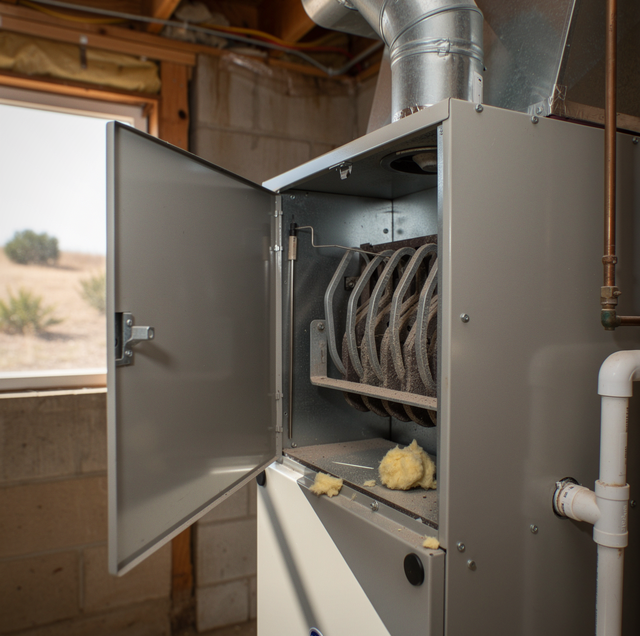
Set your thermostat to heat, and a fixed sequence begins inside the furnace cabinet. The thermostat closes a circuit and calls for heat. The control board starts the inducer motor, also called the draft motor, which pulls air through the heat exchanger and pushes exhaust out the flue. Once that airflow is moving, a pressure switch senses it and closes, proving to the board that the exhaust has somewhere to go. Only then does the board energize the igniter, either a hot surface igniter that glows or a spark igniter that ticks. With the igniter live, the gas valve opens, and gas flows out through the burner ports.
Quick Answer: A loud bang when a gas furnace starts is usually delayed ignition. Gas reaches the burners but fails to ignite on cue, and the accumulated volume lights at once. That is a combustion fault worth diagnosing promptly.
That last step is where the bang lives. Gas is supposed to light the instant it meets a hot igniter or a live spark, and the flame is supposed to travel cleanly across every burner in the row. When it does not light on cue, the valve is already open, so gas continues to flow into the burner compartment and accumulates there for a moment. When it finally reaches an ignition source, the entire accumulated volume ignites in a single event rather than burning steadily across the ports. That single event is the bang you hear.
Naming the sequence first makes every cause below legible, because each one interrupts a specific step in the sequence.
If you smell gas, see soot, notice a yellow flame rather than blue, or hear a carbon monoxide alarm, leave the building, then call the gas utility or emergency services. Carbon monoxide is odorless, so smell proves nothing.
Delayed Ignition and What Causes It
Delayed ignition is the most serious explanation for a startup bang, and the most common. The mechanism is always the same: a gap between the gas valve opening and the gas lighting. What differs is why.
Dirt and debris on the burners: Burners are shaped to hold a specific flame pattern and to carry that flame from one burner to the next. Rust flakes, dust, lint, and scale sitting on or in the ports interrupt that carry, so the far burners light late while gas from them keeps flowing. In climates where a furnace runs only a few weeks a year, burners collect dust through the long off-season; where it runs most of the winter, the same buildup arrives from runtime and a loaded filter.
Burners that have shifted out of alignment: Burners sit in slots and must aim their flame at a set spot. One knocked out of position by service work or vibration puts the flame where the next burner cannot pick it up.
A weak or fouled igniter: A hot surface igniter degrades over its life and can glow convincingly without being hot enough to light gas immediately. A spark igniter with a poor gap or a cracked ceramic does the same in a different way.
A flame sensor that cannot prove flame: The sensor works on flame rectification, passing a tiny current through the flame back to the control board. A sensor coated with residue reads a weak or no signal, so the board treats a good flame as no flame, closes the gas valve, and retries. Each retry is another chance for a rough light.
Gas pressure that is off: Pressure at the valve running low or high affects how gas leaves the ports and how quickly it ignites. Those are readings a technician takes with a manometer during a live cycle, not something anyone judges by sound.
A partially blocked burner port: A single obstructed port disrupts the flame pattern across the entire assembly.
Every item on that list sits behind the burner compartment panel, and every one of them is licensed technician work.
Do not open the burner compartment panel, brush or wash a burner, sand or wipe a flame sensor, touch an igniter, adjust anything on the gas valve, or attempt to relight the system. That work is licensed technician territory only.
A rough light that keeps repeating is a reason to shut the system off at the thermostat and call, not a reason to look inside.
When the Bang Happens at Shutdown, Not Startup
A bang as the burners go out is a different fault from a bang as they light. Naming which one you heard gives a technician a real head start on the cause.
At the end of a heating cycle, the control board closes the gas valve, the flame goes out, the inducer runs on briefly to clear the flue, and the blower keeps moving air until the heat exchanger cools. A bang in that window usually points to the flame dying unevenly across the burners, at a gas valve that is not closing crisply, or at the heat exchanger and flue metal contracting as it cools.
The first two are combustion problems, in the same family as delayed ignition. The third is only metal moving. They sound alike through a wall, which is why a technician watches a full cycle end at the furnace.
Duct Expansion and the One Benign Cause
Supply and return ducts are large panels of sheet metal. When the blower starts and warm air pressurizes them, a flat panel can pop outward and snap back, a flexing motion called oil-canning, then reverse when the blower stops.
This is the one cause on the list that is not combustion, and it sounds different. Oil-canning is a lower, hollow, wobbling boom that seems to come from a wall or a run of duct rather than from the furnace, and its timing follows the blower, not the burners. The furnace lights quietly, the blower delay-on timer waits for the exchanger to warm, the blower engages, and then the noise arrives.
Benign in origin, it means nothing to fix: a duct that oil-cans every cycle is usually holding pressure it was not built for.
Restricted Returns, Closed Vents, and Static Pressure
Static pressure is the resistance the blower has to push against. An undersized duct system, a return path too small for the equipment, crushed flexible duct in an attic, supply registers closed off in unused rooms, or a filter loaded with debris all raise it.
High static pressure makes duct panels flex harder and louder, strains the blower motor, and slows air across the heat exchanger, which changes how much heat the metal sheds each cycle. A technician measures static pressure and temperature rise and compares both against that model's rated range.
Two checks belong to you and require no tools: change a dirty or overly restrictive filter, and make sure supply registers and return grilles are open and not blocked by furniture or rugs.
How to Tell a Bang from Other Furnace Sounds
A crisp tick or click at the start of a cycle is normally a spark igniter or a relay on the control board, and by itself it is routine. A soft whoosh as the burners catch is a normal light. A bang is short, hard, and singular, and it lands at a repeatable point in the cycle.
If you can safely record the sound from a doorway on a phone, do it. The timing captured against the rest of the cycle tells a technician more than any adjective.
| When you hear it | Likely mechanism | Next Step |
|---|---|---|
| Right as the burners light | Delayed ignition, accumulated gas igniting at once | Shut off at the thermostat and schedule a diagnosis promptly |
| Every cycle, and getting harder | Repeated rough ignition | Stop using the heat and call |
| As the burners go out, at cycle end | Uneven flame shutoff, valve behavior, or cooling metal | Diagnose; do not assume it is only metal |
| When the blower starts or stops, not at light-off | Duct panels flexing under pressure change | Lowest urgency; check filter and vents, raise at next service |
| A scrape or rattle that continues while air moves | Blower wheel or loose panel, not combustion | Not an emergency, still worth a look |
Separating a Combustion Cause from an Airflow Cause
A technician's diagnosis works by ruling out causes rather than guessing from the sound alone. Watching a full heating cycle settles most of the ignition sequence at once: an igniter that glows but never reaches its lighting temperature, a pressure switch closing on a stuck contact instead of real draft, or gas visibly lighting late across the burner row all show up during that watch, and a clean, on-time light across every burner rules delayed ignition out.
If the sequence looks clean, gas pressure at the valve and flame sensor current separate a lighting fault from a signal fault: a weak sensor reading despite a strong visible flame rules in the sensor rather than the burners themselves.
Static pressure and temperature rise rule airflow in or out as a contributor. High static pressure that tracks the blower rather than the burners points at duct or return restriction, not combustion, which is why that measurement gets checked before anyone assumes the burners are at fault.
Only once combustion and airflow are both accounted for does the heat exchanger get its own separate look, because a crack there is its own finding, not a conclusion drawn from the bang alone.
What a Bang Does and Does Not Say about the Heat Exchanger
A bang is what most people fear is the sound of a cracked heat exchanger. It is not. A bang is a combustion event in the burner compartment; a crack is a condition of the metal. One does not establish the other.
The connection that does exist runs forward in time: repeated rough ignition is hard on the exchanger, which is a reason to correct the ignition fault promptly, not a reason to conclude the metal is already compromised. A furnace that bangs on startup is not a system to live with through a season and revisit later.
Frequently Asked Questions
Yes. A flame rollout switch near the burner opening trips when heat or flame escapes where it should not, cutting power to the gas valve. Many are one-time devices meant to be replaced rather than reset. A furnace that keeps locking out this way is reporting that flame is leaving the burner area, and resetting it repeatedly strips the protection instead of fixing the cause.
It does. Two-stage and modulating furnaces light on low fire and step up to high fire as demand rises, so a rough light can appear on one stage and not the other. A bang you notice only on mild days, when the equipment may never leave low fire, is worth reporting. A technician forces both stages during testing.
It can. Natural gas and propane burn at different pressures and need different burner orifices, so converting a furnace from one fuel to the other takes a matched kit and a valve set for that fuel. A conversion left partly done can produce rough ignition from the first day. Tell the technician what fuel the furnace runs and whether it was converted.
On a sealed-combustion furnace, two plastic pipes run through a wall or roof: one draws combustion air in, the other vents exhaust. A bird nest, a debris-packed insect screen, drifted snow, or piled leaves at either termination changes what the burner receives. Looking at those pipes from the ground is safe. If something is lodged inside, leave the removal to the technician.
Indirectly. A thermostat with dying batteries, or a loose wire at its terminals, can drop and remake the call for heat in quick succession, forcing repeated ignition attempts. Fresh batteries and confirming that the thermostat is set to heat are reasonable checks you can make yourself. If the call is unstable, the technician verifies it at the control board.
It can. After the system sits off for hours, condensation can form on a cold flame sensor or igniter, and that thin film is often enough to disrupt just the very first light of the day; the surface dries almost immediately, so the next several cycles that day run clean. A bang that repeats on every call, with no such quiet stretch afterward, points to a fault in the assembly itself rather than a one-time moisture effect.
Have that startup bang diagnosed before the next heating cycle — a licensed technician watches the full ignition sequence and finds the fault behind the noise. Fix My Air DFW serves Fort Worth and the DFW metro. TACLA33709C. Call (817) 439-9811.