
New AC Short-Cycling: Oversizing Is the Last Thing to Blame
A correctly matched cooling system runs 10 to 20 minutes once the compressor starts, and longer as the load rises. A new install that shuts off at 6 minutes, restarts 4 minutes later, and repeats all afternoon is short-cycling. The number that matters is run minutes, not cycles per hour: two 20-minute runs and six 6-minute runs add up to nearly the same hour of cooling, and only one of them is a fault.
Short run times on new equipment are a fault condition, not a break-in quirk. A compressor draws several times its running current at every start, and that heat lands in the motor windings, so a system making three or four times the starts it was designed for pays for it there. A system that runs and runs without pulling the house to setpoint is the opposite complaint and belongs elsewhere.
Almost everyone arrives at the same first answer: the new unit is too big. Oversizing is real; it happens often, and it does produce short cycles. It is still the last thing a technician should conclude, because several installation-specific faults produce the same pattern and are correctable without altering the equipment's size. What follows is the order they are actually found.
The Thermostat's Location Ends the Cycle Before the House Is Cool
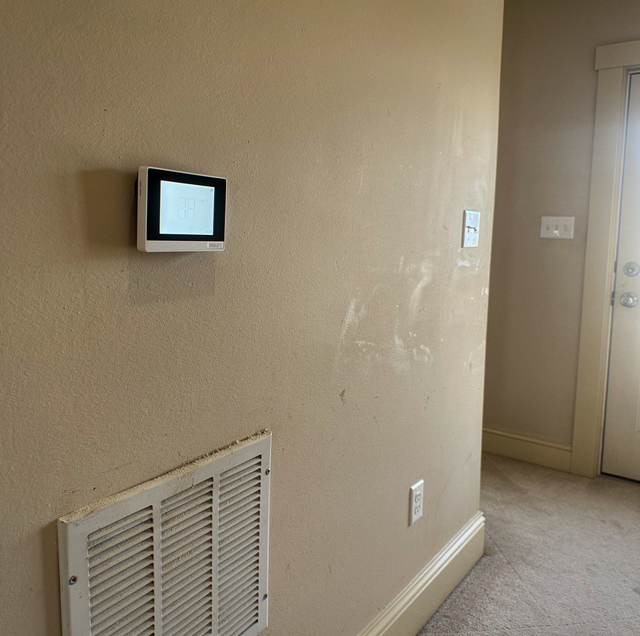
A thermostat is a thermometer with a relay behind it. It knows only the air touching its own sensor and ends the call when that air reaches setpoint, whatever the rest of the house is doing. Air leaving a cooling coil is roughly 18 to 22 degrees cooler than the air returning to it, so a supply register throwing that stream across a thermostat face satisfies the setpoint in minutes while the far bedrooms have barely started to move. An exterior wall does the same through the drywall, as does sun crossing it or heat off a nearby lamp.
This is the commonest cause on a new install for a plain reason: the thermostat is usually replaced during the job, sometimes relocated, and nearby grilles move too. The correction is an interior wall, 52 to 60 inches above the floor, out of direct sun and away from supply air and door swings.
Time three cycles back to back with a phone stopwatch at a steady outdoor temperature, writing down run minutes and off minutes for each. Three runs under ten minutes is data a technician can act on.
Cycle Rate and Differential Are Settings, Not Symptoms
Two software values in the thermostat determine how long a cycle lasts, and both are set during commissioning. The differential, sometimes labeled swing, is how far room temperature must drift past setpoint before a call begins and ends. At 0.5 degrees, a small local air change ends the run; at 1.0 or 1.5 degrees, the same system runs longer per cycle at the same average temperature.
Cycle rate, in cycles per hour, is a ceiling the thermostat enforces on itself, adjustable on most models from 1 to 6. Cooling belongs at 2 or 3. Gas heating is often set at 5, and a stat configured quickly carries that number to the cooling side, where it chops the run short by design. Both values sit in the installer menu, and reading them costs nothing.
Restricted Airflow Trips the Coil Before the Setpoint Arrives
Cooling equipment is designed around roughly 350 to 400 cubic feet of air per minute per ton. Move less than that across the evaporator, and the coil runs colder than intended, suction pressure falls with it, and the system either opens a low-pressure control or frosts the coil until a freeze sensor stops the compressor. Both reset once the coil warms, so the pattern reads like a thermostat problem.
A filter is the fastest way there. A one-inch pleated filter at a high MERV rating, in a grille that was adequate behind the old blower, can pull airflow under the design number on its own. Closed supply registers and a return grille behind a sofa do the same from the other end. Those three are all a homeowner should check on the equipment.
Duct That Was Never Matched to the New Blower
Most residential air handlers are rated to deliver design airflow against a total external static pressure of 0.5 inches of water column. Field measurements on existing duct routinely land at 0.8 to 1.0 or higher, because that duct was sized for different equipment and never touched when the new system went in. A manometer at the air handler settles it. Frost on the outdoor unit points to a different fault set and is not part of this rule-out.
Oversizing Is Real, and It Is a Diagnosis of Exclusion
Equipment is supposed to be chosen in two steps. The load calculation is a room-by-room accounting of heat gain from construction, orientation, glazing, insulation, air leakage, and occupancy. The equipment selection step follows against that number, and industry guidance is to land within about 15 percent above the calculated cooling load rather than rounding up freely. Sizing by square foot, or by matching the old unit's tonnage, skips both and is how oversizing enters a house.
An oversized system reaches setpoint faster than the load can reload the room, so every cycle is short by definition. The part that gets missed is moisture. A coil removes water only when its surface sits below the dew point of the air passing over it, and it stays wet, which takes several minutes of continuous running. Cut every run short, and the coil never gets there, so indoor humidity climbs while the thermostat reports a satisfied setpoint. Comfortable indoor relative humidity sits near 45 to 55 percent, and a house holding setpoint at 60 percent feels cool and clammy. That pairing is the signature of too much capacity.
Now the honest part. Oversizing rarely drives run times under five minutes at high outdoor temperatures because, at high load, even generous capacity has work to do. What it produces is short cycles in mild conditions with a humidity complaint alongside. A unit stopping at four minutes on the hottest afternoon of the year is being stopped by something, not satisfied. Confirming oversizing means running the load calculation the house should have had before the equipment was ordered, and that verdict holds only once the causes below are cleared.
Control Wiring and Staging Setup Get Configured, Not Just Connected
A thermostat has to be told what it is driving: system type, cooling stages, fan behavior, and often matching dip switches on the air handler board and the outdoor unit. A two-stage or variable-capacity system, left configured as a single stage, jumps to full output on every call, shortening every run. Which staging arrangement the house should have been sold with gets decided before installation day, and a misconfigured unit behaves badly regardless.
A staple driven through thermostat cable, a nicked conductor in the whip, Y and W landed on the wrong terminals, or a jumper left across R and Rc on a system wired with separate heating and cooling power supplies all produce intermittent calls that read as cycling.
Charge and Line-Set Faults Get Introduced on Installation Day
Charge is set by weight, not by feel. The outdoor unit ships factory-charged for a set line length, commonly 15 or 25 feet, with refrigerant added per foot beyond that and verified by subcooling or superheat. Skip the adjustment, or lose refrigerant through a weeping flare or a cold brazed joint, and suction pressure falls until a low-pressure control opens the circuit, which restarts once the low side recovers and repeats.
Too much refrigerant, or air and moisture left in a system never evacuated to 500 microns and held, drives head pressure up instead and stops the compressor from the other direction. Brazing without a nitrogen purge leaves copper oxide scale inside the lines, which travels to the filter-drier and the metering device, restricting flow. Reusing the old line set carries the previous system's oil and debris in for the same reason.
The sealed refrigerant circuit is federally regulated and is never checked, topped off, or adjusted by a homeowner. Opening an air handler or condenser cabinet exposes line voltage and stored capacitor energy that remains after the disconnect is pulled.
Safeties and Pressure Switches Stop the Compressor Without Announcing It
Every safety in the system ends a cycle silently. A condensate float switch in the secondary pan or spliced into the primary drain opens on a line run without enough fall, or on a trap that picked up construction debris, killing the call until the water drains. Nothing on the wall says why.
On the refrigerant side, a high-pressure switch on R-410A equipment commonly opens near 610 psig and resets near 420, reached through a condenser coil blocked by packaging debris, a fan running backward on reversed leads, or a fan motor not coming up to speed. A low-pressure switch typically opens near 50 psig and covers the undercharge case from the other end, and a compressor's internal overload opens on winding temperature. A run capacitor that has failed outright prevents the compressor from starting at all, resulting in a no-cool call rather than a cycling one.
The order matters more than any single item on it. Static pressure, wiring, configuration, charge, and safeties are each measurable in one visit, each with a number that indicates whether it clears or not. Only when all of them come back clean does equipment size become the answer. Ask for the load calculation, the static pressure readings, and the charge verification numbers from installation day; a new system carries an installer and a manufacturer behind it, each with its own terms.
Frequently Asked Questions
Reading them is fair game and worth doing before the call: differential and cycle rate both sit in the installer menu and cost nothing to look at. Changing them is a different matter. The same menu sets the minimum compressor off time, usually a fixed 300-second delay, so the high and low sides can equalize before a restart. Shortened, the compressor starts against a loaded head and pulls locked-rotor current until it starts or trips. Write the values down and hand them over rather than adjusting anything.
The hole cut for the thermostat cable opens into a stud bay that can connect to an attic or an exterior wall cavity. Air moving along that path washes across the back of the sensor, pulling the reading away from the room. Packing the wire penetration with fire-rated putty behind the mounting plate is a standard correction.
Many current thermostats accept remote indoor temperature sensors, wireless or wired, and can be controlled by a chosen sensor or by an average of several. The control stays where the wiring runs while the system responds to a room that represents the real load.
Look at the blower off-delay. Many air handlers run the fan 45 to 90 seconds after the compressor stops, and during that window, air passes over a coil that is still carrying condensate and re-evaporates part of it into the house, once for every extra cycle the system makes. Where the board offers a selectable delay, shortening it recovers moisture removal those cycles were giving back.
It happens, and it changes both rated capacity and the metering device the system was designed around. Outdoor units, indoor coils, and air handlers are tested and rated as combinations, and a legitimate pairing carries a certified reference number issued for that exact combination. Ask for that number and confirm the equipment nameplates match the models it lists.
A thermostatic expansion valve meters refrigerant using a sensing bulb clamped to the suction line, and the bulb needs metal-to-metal contact plus insulation to read the line rather than surrounding air. On suction lines 7/8 inch and larger, the bulb belongs at the 4 or 8 o'clock position, away from the oil pooling at the bottom. A loose, bare, or badly clocked bulb feeds it false superheat, and the valve hunts hard enough to swing suction pressure into a low-pressure cutout.
Book a short-cycling diagnostic on your new system — get run times, static pressure, and charge verified against the load your house actually has. Fix My Air DFW serves Fort Worth and the DFW metro. TACLA33709C. Call (817) 439-9811.
