
Why Is My AC Blowing Warm Air? 7 Causes, Simplest First
Warm air from the vents on a day you need cooling is one of the most common calls an HVAC tech gets, and it almost always traces back to a single idea most homeowners have backward. Your air conditioner does not make cold air. It cannot manufacture cold the way a stove manufactures heat. What it does is grab the heat already inside your house, carry it outside on a stream of refrigerant, and dump it into the outdoor air. Cool supply air is just the leftover air once the heat has been removed.
That distinction matters because it tells you what "warm air" means. If the vents blow room-temperature air, the heat-removal cycle has broken somewhere along the chain, and the blower is just pushing around air that never had its heat pulled out. Something between the thermostat, the indoor coil, the refrigerant loop, and the outdoor unit has stopped working. The chain has only a handful of failure points, and you can walk them from simplest to most serious.
Quick Answer: Warm air means the heat-removal cycle stopped somewhere. Start simple: set the thermostat to "auto" and "cool," check whether the breaker to the outdoor unit has tripped, replace a dirty filter, clear the outdoor unit, and look for ice on the coil or lines. If the outdoor unit is silent or you find ice, refrigerant, or an electrical fault, that is a licensed-tech job. Do not open the sealed refrigerant system or the energized outdoor unit.
Start With The Thermostat, Not The Equipment
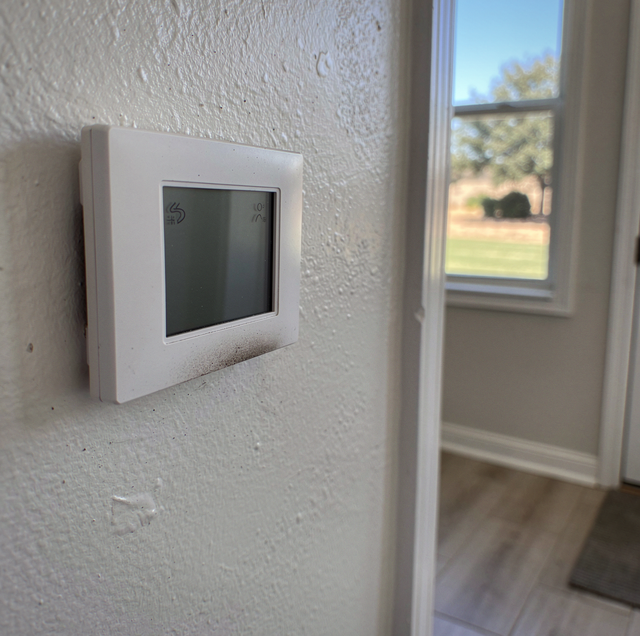
Before anyone touches a panel or a breaker, check the thermostat, because the most common "warm air" complaint isn't a broken part at all. Two settings cause it.
The first is the fan setting. A thermostat lets you set the fan to "auto" or "on". On "auto," the indoor blower only runs when the system is actively cooling, so every gust from the vent has passed over a cold coil. On "on," the blower runs nonstop, all day, even during the long stretches between cooling cycles when the coil is warming back up. During those off-cycles, the fan is still moving air, but that air is just room-temperature house air. It feels warm because it is warm. Flip the fan back to "auto," and the problem often disappears on its own.
The second is mode. It sounds obvious, but a bumped or mis-programmed thermostat set to "heat" or "fan only" will happily run the blower without ever calling for cooling. Confirm the mode reads "cool" and the setpoint is a few degrees below the room temperature.
Check The Breaker To The Outdoor Unit Once
Here is a detail that trips up many homeowners: your indoor blower and outdoor condenser are usually on separate electrical circuits. That is why you can stand at a vent, feel air moving, and still get no cooling. The blower runs on its circuit while the outdoor unit, which houses the compressor doing the actual heat removal, sits dead on a tripped breaker.
Go to the panel and look for a tripped breaker labeled for the AC or condenser. Reset it once, firmly, all the way off and then back on. If it holds, great. If it trips again immediately, stop. A breaker that keeps tripping means a genuine fault downstream, a shorted component, or a failing motor drawing too much current, and resetting it repeatedly risks damage or fire. That is a call to a tech, not a fourth reset.
Airflow: The Filter And The Iced-Over Coil
Now the mechanical causes, where the "AC removes heat" idea pays off. The indoor evaporator coil needs a steady flood of warm house air across it to work, and that warm air is what keeps the cold coil from getting too cold. Choke off the airflow, and the physics turns against you fast.
A clogged filter is the usual culprit. When the filter is packed with dust, far less air reaches the coil, its temperature keeps dropping past the point where the moisture on it freezes, and it frosts over. That ice insulates the coil and further blocks airflow, so the freeze accelerates until the coil is a solid block. Almost no air gets through, and what does is not cooled, because ice is a poor heat exchanger. You get a trickle of warm air.
It works like breathing through a thick scarf on a cold morning: the moisture in your breath keeps freezing onto the fabric, the fabric clogs, and each breath gets harder until you are barely moving any air at all. The coil does the same thing.
If you find ice, shut the system off at the thermostat and let the fan run without cooling, or switch everything off entirely, and give the coil time to thaw fully before you run it again. Running a frozen system just piles on more ice and can push liquid refrigerant back toward the compressor. While it thaws, replace the filter. A fresh filter restores the airflow that keeps the coil in its normal operating range.
The Outdoor Coil Does The Other Half Of The Job
The indoor coil collects heat; the outdoor coil sheds it. Those aluminum fins on the outdoor unit release the captured house heat into the outside air, and they can only do that if air moves freely through them. Grass clippings, cottonwood fluff, and a season of dirt cake onto the fins and blanket them. The unit can no longer dump heat efficiently; pressures climb and cooling drops off.
You can help here safely. With the unit off, clear leaves and debris from around it, and gently rinse the fins from the outside with a garden hose on low pressure. Keep a couple of feet of clearance around the cabinet. What you should not do is pull the panels or reach into the unit: the fins bend easily, and there are energized electrical components inside a recently powered condenser.
When It Is The Refrigerant, The Capacitor, Or The Compressor
Past this point, you are into repairs that belong to a licensed tech, and it helps to know what they are so you can describe symptoms.
Low refrigerant is the one people reach for first and understand least. Refrigerant is not a fuel that burns off. It circulates in a sealed loop and never gets "used up." So if the charge is low, there is a leak, and the level will keep dropping until the leak is found and repaired. A system limping along on a low charge cannot absorb enough heat, so the coil runs too cold and often freezes, and the supply air drifts warm. Refrigerant work is sealed-system work; it is regulated and, under federal EPA rules, only a certified technician may handle it. This is never a DIY fix.
Then there are the electrical parts that start the outdoor unit. The run capacitor delivers the jolt of energy the compressor and fan motors need to get moving. The contactor is the heavy-duty switch that sends power to the outdoor unit when the thermostat calls for cooling. When either fails, the compressor never spins up, no heat gets removed, and the vents blow warm even though the thermostat is calling and the indoor fan is running. A failed compressor, the pump at the heart of the system, produces the same warm-air result and is the most serious of the lot.
A Quick Way To Narrow It Down Yourself
You can split the possibilities in half by listening. Walk outside and notice whether the outdoor unit is running.
If the indoor fan is blowing but the air is not cold, and the outdoor unit is running, suspect the thermostat setting, an airflow problem such as a dirty filter or a frozen coil, or a low charge. The heat-removal machinery is turning; something is choking or starving it.
If the outdoor unit is silent, dead quiet, no hum, no fan spinning, suspect the electrical side: a tripped breaker, a failed capacitor, or a bad contactor. The heat-removal machinery is not even turning on.
That one observation tells a tech a lot before they arrive, and it tells you if your homeowner checks have any chance of solving it.
This Is A Year-Round Fault, Not A Summer One
It is tempting to blame warm air on a brutal afternoon, and heat load is real: on the hottest stretch of the day a system that is already marginal, low on charge, running a dirty coil, or nursing a weak capacitor, cannot keep pace with the extra heat pouring in, so it falls behind and the supply air feels warm. But the heat only exposes the fault; it does not cause it. That same weak capacitor, slow leak, or clogged filter will blow warm air on a mild spring afternoon, too, just less dramatically. Treating it as a summer-only nuisance lets the real problem ride along until it fails outright. The load is one stressor among many; the fault lives in the equipment and needs fixing, whatever the calendar says.
What You Can Safely Do, And Where To Stop
To recap the split. On your own, you can set the thermostat to "auto" and "cool," reset the outdoor breaker exactly once, replace a dirty filter, clear and gently rinse the outdoor unit, and shut a frozen system down so the coil can thaw. Those cover the harmless causes.
Where you stop: anything involving refrigerant, a capacitor or contactor, the compressor, or a coil that needs professional cleaning. Do not open the sealed refrigerant lines and do not remove panels on the energized outdoor unit. Those carry real electrical and pressure hazards, and refrigerant is legally a certified technician job.
Frequently Asked Questions
The thermostat fan is most likely set to "on" instead of "auto," so the blower keeps running during the long off-cycles and pushes un-cooled house air through the vents. There is a second reason to leave it on "auto" in humid weather: with the fan running nonstop, air keeps sweeping the cold coil after the compressor stops, re-evaporating the condensate sitting on it and blowing that moisture back into the house as damp air, raising your indoor humidity. Switching to "auto" ties the blower to active cooling and lets that condensate drain away instead.
Yes. The indoor blower and the outdoor condenser are commonly wired to separate circuits, so the fan can keep moving air while the compressor sits dead. To find the right breaker, look for the double-pole 30 to 60 amp breaker feeding the outdoor unit, the one that occupies two slots and switches both legs together. Reset it once. If it trips again immediately, stop resetting it: a repeat trip signals a real fault downstream, not a nuisance trip, and forcing it back on risks damage.
A badly clogged filter starves the coil of airflow, and without that warm air passing over it, the coil keeps dropping until moisture frosts into a solid block of ice, at which point almost no air gets through, and what does is warm. Plan for the thaw to take time: a fully iced coil can need several hours to melt clear, and you speed that up by running the system in fan-only mode, which moves room air across the ice without the compressor making more of it. Once it is fully thawed, install a clean filter before running the cooling again.
Watch for ice built up on the copper line running into the outdoor unit, a hissing or bubbling sound near the lines, and cooling that gradually fades over weeks rather than failing all at once. Because refrigerant only drops when there is a leak in the sealed loop, simply topping it off without locating and repairing that leak is a temporary patch, and the diagnosis and repair are work a licensed technician has to handle.
The run capacitor delivers the burst of energy the compressor and fan motors need to start turning, and the contactor is the switch that sends power to the outdoor unit when cooling is called for. If either fails, the compressor never starts, and the vents blow warm even while the thermostat calls for cool. Each leaves a visible tell: a failed run capacitor often has a bulged or domed top instead of a flat one, while a bad contactor shows pitted or burnt contacts and sometimes an audible chatter as it tries to pull in. Both are diagnosed and replaced by a tech.
During the hottest part of the day, the heat load peaks, and a marginal system cannot keep up, so it falls behind. At night, under a lighter load, it coasts along fine. One measurement narrows down the why: check the temperature split between the supply and return air. A healthy system drops the air by roughly 16 to 22 degrees across the coil, and a smaller split than that points to a low refrigerant charge or an airflow restriction, which is exactly the kind of marginal fault that a heavy afternoon load exposes.
Book a diagnostic — get the real cause found and fixed by a licensed tech instead of guessing at the vent. Fix My Air DFW serves Fort Worth and the DFW metro. TACLA33709C. Call (817) 439-9811.
