
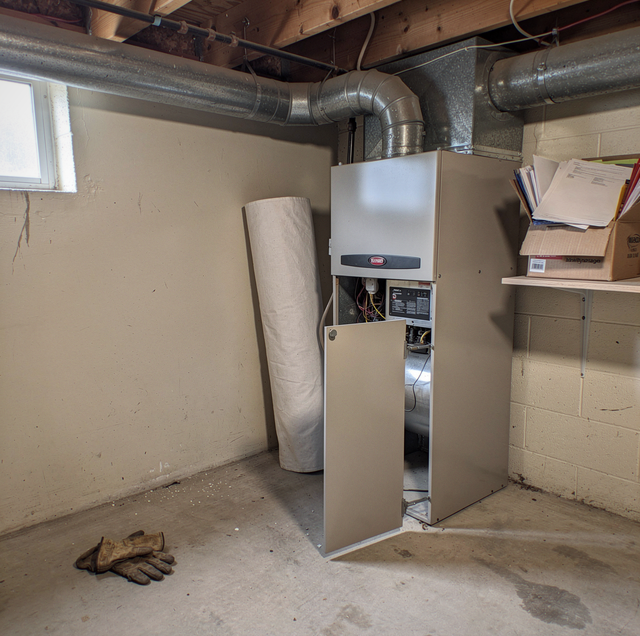
A gas furnace heats in a fixed order. The thermostat calls, the board energizes the inducer motor so combustion gases have a path out the vent, the burners light, and after a short delay the blower starts moving warm air into the house. The burners then stay lit until the thermostat is satisfied and drops its call. A furnace that shuts off early breaks that order: the burners go out while the thermostat is still calling, and after a pause the furnace starts the sequence over. That stop is the furnace's own safety controls reacting to a condition they were built to catch, and the moment in the cycle when the flame goes out tells you which control acted.
On a thermostat that shows when it is calling for heat, the display settles the first question. If it still shows a call when the burners go out, a control inside the furnace stopped them. If it shows the setpoint reached while the far rooms are still cool, the thermostat ended the call.
Each stopping pattern aligns with the control or condition involved and with the part a homeowner can safely confirm.
| When the furnace stops | Control or condition involved | What you can safely confirm |
|---|---|---|
| Burners light and go out within seconds, then the furnace retries | Flame sensing | Nothing inside the cabinet; note how long the flame lasted |
| Runs several minutes, burners shut off with the blower still running, then relights | High-limit switch and overheating | Filter condition, supply registers open, return grilles clear |
| Runs normally in mild weather, stops early on long calls | Airflow restriction under a heavy load | Filter condition, blocked returns |
| Stops early and the air at the registers feels hotter than it normally does | Overheating from low airflow | Closed registers, rugs over floor grilles |
| Thermostat display resets or goes blank when it stops | Power to the thermostat | Nothing at the wiring; note when the display blanks |
| Shuts off right after the inducer starts, before any flame | Pressure switch, inducer or vent | Nothing at the cabinet or vent; note the timing |
Burners That Light and Drop Out Within Seconds
Once it opens the gas valve, the control board requires proof that gas is burning. A flame sensor, a thin metal rod set where the burner flame wraps around it, returns a small electrical signal to the board while flame is present. The board allows a trial period of a few seconds after the gas valve opens. If the signal is missing or fades, it closes the valve, lets the inducer clear the heat exchanger, and tries again. After a set number of failed tries, it stops trying and locks out.
This pattern fits a flame-proving failure. Burners that light, burn visibly for a moment, and then go out may have been burning well; the board shut them off because it could not confirm them. A sensor coated with a thin layer of oxide or residue is one cause. Others include a sensor bent partly out of the flame, a cracked ceramic insulator around the rod, and a weak or lifting flame from gas pressure that is off, which does not wrap the rod firmly enough to give a steady signal.
Because the flame goes out so soon after lighting, the blower has not had time to come on. The sensor sits in the burner compartment with the igniter and gas valve, and cleaning, sanding, or bending it is technician work; your contribution is timing.
Overheating and the High-Limit Switch
The high-limit switch watches temperature at the heat exchanger or the supply side of the furnace. The burners deliver a fixed amount of heat to the heat exchanger, and the blower's job is to carry that heat into the ducts. When the air moving across the metal drops, heat builds up at a rate the airflow cannot carry away, the temperature at the limit climbs past its setting, and the switch opens. The board shuts off the gas and keeps the blower running to cool the heat exchanger, then relights the burners once the switch closes again. The signature is burners going quiet while air keeps blowing from the registers, and a house that warms in fits.
Restricted airflow is the underlying cause. A clogged filter is one source. Closed supply registers in rooms nobody uses reduce the air the blower can move, and so does a return grille hidden behind a sofa or a rug laid over a floor return. Inside the cabinet, a blower wheel caked with dust moves less air at the same motor speed, and a weakening blower motor turns more slowly than it should. On furnaces whose blower motor runs with a capacitor, a failing capacitor holds the motor back the same way.
Mild days can hide the problem, since a short call ends before the heat exchanger reaches the limit's setting, while a long call gives the same restriction time to push the temperature up. Air at the registers that feels hotter than normal is the same condition seen from the other side: less air crossing the same heat exchanger picks up more temperature on the way through.
Each limit trip means the furnace overheated or the switch is worn; a cracked heat exchanger is its own problem with its own warning signs.
The Pressure Switch, the Inducer and the Vent
Before any flame, the furnace has to prove that exhaust has a way out. The inducer motor runs first, creating a draw from the burner area to the vent. A pressure switch, connected by a small rubber tube to the inducer or its housing, closes when it senses that draw. The board holds the gas valve shut until that switch closes.
If the switch does not close, the inducer runs, nothing lights, and the board shuts the inducer down and tries again. The same switch stays in the circuit during the burn, so if the draft weakens partway through a cycle, the switch opens, and the gas shuts off at once.
Conditions that keep the switch from proving draft include a blocked or partly blocked vent, an inducer motor that is slowing or failing, a cracked or kinked switch tube, and worn switch contacts. On some high-efficiency furnaces, water is part of the picture: those furnaces produce condensate as part of normal operation, and a clogged trap or drain line can hold water where it disturbs the pressure the switch reads. A vent problem is also a combustion safety problem, since exhaust that cannot leave has to go somewhere.
When the Thermostat Ends the Call Early
Some early shutdowns are the thermostat working from bad information. It reads only the air around its own sensor. Mounted near a supply register, above a lamp or television, or on a wall that catches afternoon sun, it warms up while the bedrooms at the far end of the house are still cold, reaches its setpoint, and ends the call. Nothing in the furnace failed; the issue lies with the thermostat's location or with the air striking it.
A screen that blanks or restarts as the furnace stops means the thermostat lost power and dropped the heat call with its display, a wiring and power-supply question for a technician; loose wiring at the thermostat or the control board does the same.
Oversizing and Flame Rollout
An oversized furnace can bring the air at the thermostat to setpoint quickly and end the call while distant rooms lag, a thermostat-satisfied stop, which the display tells apart from a safety-control stop. Flame rollout is a separate control: a rollout switch mounted by the burners opens when flame curls out of its intended space, and where it is a manual-reset or one-time part, the furnace stays off instead of relighting.
Resetting the Furnace Repeatedly Masks the Fault
Turning the furnace switch off and on, or flipping its breaker, can clear a lockout and restore heat for a while. It repairs nothing. A limit or pressure switch that keeps opening indicates heat buildup or a draft problem, and restarting it over and over sends the furnace back into that condition while erasing the pattern a technician needs to see.
A gas smell means leaving the house and calling the gas utility from outside, without operating light switches or the thermostat on the way out. A carbon monoxide alarm means everyone gets out.
Where Your Checks Start and Stop
Your part covers what sits outside the cabinet. Replace a loaded filter with the same size and type the furnace already uses. Walk the house and open every supply register, including rooms you keep closed. Clear furniture, rugs, and stored boxes away from return grilles. Note whether a supply register, a lamp, or daytime sun reaches the thermostat. Then watch one full heat call and write down when the burners went out, whether the blower kept running, and what the thermostat showed at that moment.
Opening the burner or blower compartment exposes live wiring, a hot heat exchanger, and the gas valve, and a bypassed limit or pressure switch can cause a furnace to overheat or exhaust to spill; such testing belongs to a licensed HVAC technician.
Frequently Asked Questions
On furnaces with a small viewing window in the lower door, the control board's status light shows through it, and after a shutdown, it flashes a fault code in the number of blinks. A phone video of the blinks gives a technician the board's own record. Some boards clear the code when power is cut, so count before anyone flips the switch.
The signal depends on more than the rod. The flame current returns to the board through the burner assembly and the furnace chassis, so a loose or corroded ground connection weakens it even with a new sensor in place. Reversed hot and neutral wires on the furnace's power supply can also defeat flame sensing on some control boards, a fault that can appear after electrical work elsewhere in the house.
That is a lockout clearing itself. Some control boards release a lockout on their own after a waiting period and begin a new round of attempts. Other boards hold the lockout until power is removed. Either way, the condition that caused the lockout will still be present when the heat comes back, and it can stop the furnace again.
It can. The blower motor on a furnace has separate speed settings for heating and cooling, chosen at installation with wire taps or control board settings. If work on the cooling side moved the heating setting to a lower speed, or a replacement motor went in without matching it, the blower moves less air during heat calls and the high limit opens even with a clean filter and open registers.
For a furnace that draws combustion air from the space around it, yes. A furnace in a closet that takes burner air from the house gets it through a louvered door or vent openings, and weatherstripping that door, blocking the louvers or packing the closet with storage can starve the burners of air. A starved flame can lift away from the flame sensor or burn unevenly. Sealed-combustion furnaces pipe their air in from outdoors and are not affected this way.
Yes. Mechanical thermostats with a mercury bulb or bimetal coil carry a small adjustable heater inside called a heat anticipator. It warms the sensor slightly during a call so the thermostat shuts the burners off a little ahead of the setpoint and lets heat already in the ducts finish the job. Set to the wrong value for the furnace's gas valve, it ends calls early and leaves the rooms short. Digital thermostats have no anticipator.
Bring in furnace repair for a heating cycle that stops short — flame sensor, high-limit switch, pressure switch and airflow diagnosis for gas furnaces. Fix My Air DFW serves Fort Worth and the DFW metro. TACLA33709C. Call (817) 439-9811.