
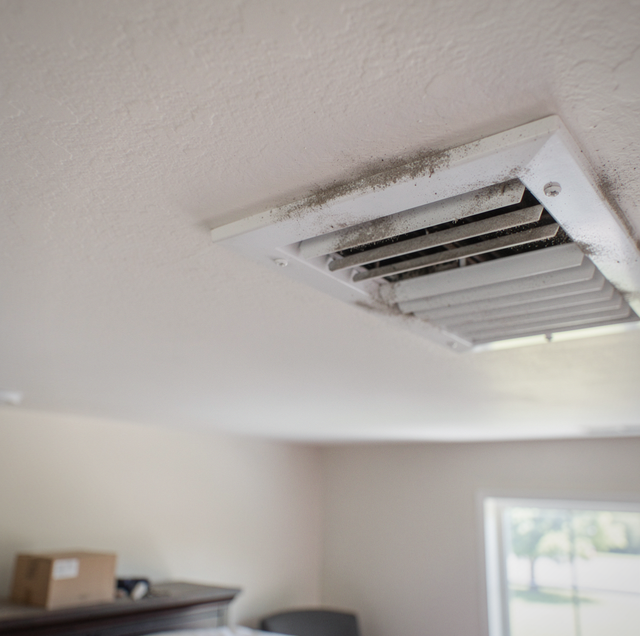
Ductwork has one job: carry cooled air from the coil to the registers without losing any on the way. When a joint opens, a boot pulls loose, or a flex run gets crushed, some of that air never makes the trip. The system keeps running, the thermostat keeps calling for cooling, and the house still takes longer than it should to catch up, because part of what the equipment made never reached a room at all.
Each sign a homeowner can notice pairs with the duct failure behind it:
| Sign | What It Points To |
|---|---|
| A room or two that never reaches the thermostat's setpoint | Conditioned air leaving that room's duct, or a closed damper or crushed run on it |
| Dust at the registers | A return leak pulling attic dust into the airstream |
| A hot attic or garage with a noticeably cold patch near a duct run, seen from the attic hatch or by whoever services the system | A supply leak dumping cooled air into that space instead of a room |
| Long run times where the house never quite catches up to the set temperature | Air lost in transit; a system short on capacity or refrigerant reads the same |
| A visible disconnected boot, an open seam, or a flex run that's crushed flat, seen from the attic hatch or by whoever services the system | A physical break in the duct itself, not a system or thermostat problem |
Where Ductwork Loses Air: Joints, Boots and Crushed Runs
A duct leak happens at a connection more than in the middle of a straight run. A metal trunk line is built from short sections joined at collars and seams, each one held with screws and sealed with tape or mastic. Any one of those joints can work loose over the years as the metal expands and contracts with the system's cycles, and once the seal opens, air takes the easier path out rather than continuing down the line to a register.
Register boots, the metal or plastic fittings where a branch duct meets the floor, wall, or ceiling opening, are another place a duct system opens up. A boot that was never fully sealed to the subfloor or drywall, or one that gets bumped loose during other work in an attic or crawlspace, leaks at the exact spot where the duct meets the house structure.
Flexible duct, the insulated tube used for shorter runs and tight spaces, fails differently. It can be crushed under stored items in an attic, kinked around a tight turn, or torn where it clamps onto a metal collar. A crushed run does two things at once: it restricts the air trying to pass through, and it strains the clamped connection until that joint opens, too. A plenum connection can loosen the same way, though that failure point behaves differently from an ordinary duct joint and calls for its own separate look.
Supply Leaks vs. Return Leaks, and Why a Return Leak Pulls In Attic or Garage Air
A leak on the supply side, between the air handler and a room's register, lets cooled or heated air escape into the attic, crawlspace, or wall cavity before it ever reaches a person. That air is gone. The room it was headed for gets less than the system produced, even though the equipment itself is working correctly.
A leak on the return side works in reverse, and that difference matters. The return duct carries air back to the system at slightly negative pressure, so a gap there doesn't let conditioned air escape; it instead pulls in nearby air. If that return run passes through an attic, it pulls in hot, dusty attic air. If it passes through or near a garage, it pulls in garage air along with anything in it. Either way, the system ends up conditioning a mix of return air and air it was never supposed to draw from, which adds load without adding any comfort.
The Signs Show Up Inside the House
Long run times read differently depending on the summer. In a long, hot summer, the system spends extended periods running as a matter of course, so runtime by itself proves nothing, and the sign to watch is a house that still fails to reach its setpoint. In a mild summer the AC works in shorter spells, so a run that keeps going without the house catching up stands out on its own.
A system that runs nonstop without the house catching up has its own separate list of causes worth checking first, and a duct leak feeding one or two rooms is only one entry on it.
Pattern is a tell of its own. A single room that lags while every other room keeps pace narrows the search to that room's own branch: a leak or a loose boot on that run, a crushed section, or a closed damper or register. A hot upstairs paired with a comfortable downstairs can have more than one cause working together, with a leak on one of the upstairs runs among them.
Dust is a return-side tell specifically. A return leak in an attic or a crawlspace pulls insulation fibers, drywall dust, or general attic grime into the airstream, and some of it settles around the registers it eventually reaches.
A return leak in a garage holding a gas furnace or water heater can starve the appliance of combustion air and pull its exhaust, carbon monoxide included, into the house; draft testing and sealing that return belong to the technician.
How a Technician Confirms and Seals a Leak
Finding a leak starts with a visual pass through the accessible duct runs, checking collars, boots, and any flex connections for gaps, torn clamps, or tape that has let go. Where the leak isn't obvious to the eye, a technician can pressurize the duct system with a calibrated fan and read how much air the system loses to reach a target pressure, which turns "the ducts are leaking somewhere" into a number a repair can be measured against. A smoke source held at a suspect joint shows whether air is escaping or being drawn in.
Sealing follows what's found. A loose or open joint gets mastic, a paste sealant brushed on by hand, or a foil tape made for duct joints; ordinary cloth-backed tape isn't used for this because its adhesive dries and lets go once it's cycled through the heat of an attic and the cold of a running coil. A boot that pulled away from the floor or ceiling gets reseated and sealed at the point where it meets the house structure, not just at the duct connection.
When a Run Gets Replaced Instead of Sealed
Sealing works when the duct material itself is sound, and the failure is at a joint. Replacement becomes the right call when the flex duct's outer jacket or insulation has torn or come apart along its length, when a run has been crushed badly enough that its round shape can't be restored, or when the inner liner has separated from the outer jacket over more than a short stretch. In those cases, patching the joint leaves a duct that's still restricted, still losing insulation value, or still likely to fail again at a new spot nearby. Replacing the damaged section resolves the problem rather than working around it.
Frequently Asked Questions
Yes. A return-side leak blends unconditioned air into the same stream that reaches the coil, so the loss shows up as the system working harder rather than as an obviously warm or cold room. In that case, the first clue can be a bill that climbs with no matching comfort complaint, which is a legitimate reason on its own to have the ducts checked.
Yes. For a test of the ducts alone, every supply register and return grille is sealed off with tape or covers, so the calibrated fan pressurizes only the duct system and the air handler cabinet. Leakage to the outdoors is a separate test run with the house itself pressurized to the same level, so the number reflects only air lost outside the living space.
Yes. A return run that passes through or near a garage can pull in whatever is airborne there, along with the temperature loss, and a return in an attic can pick up insulation fibers the same way. A smell that comes and goes with the blower running is worth mentioning to whoever inspects the ducts.
It can. Air that used to leak out near the air handler now reaches the registers, so rooms at the ends of long runs can pick up flow, while rooms near the unit get more than they need. Where the branch runs carry balancing dampers, they are reset after sealing, so the gain is spread instead of piling into the nearest rooms.
Yes, and it's the same physical duct doing both jobs. A joint that leaks cooled air in summer leaks heated air in winter, through the same opening, so sealing it once covers both seasons rather than needing a separate repair when the system switches modes.
New duct systems can leak too. A missed screw at a boot, a seam that wasn't fully taped during installation, or a clamp that wasn't tightened all the way can leak from day one. Leak risk starts with how well each connection was made, and years of heating and cooling cycles add to it.
Line up a ductwork inspection and sealing visit — the ducts are pressure-tested, leaking joints, boots, and crushed runs are sealed or replaced, and the leakage is measured again afterward. Fix My Air DFW serves Fort Worth and the DFW metro. TACLA33709C. Call (817) 439-9811.