
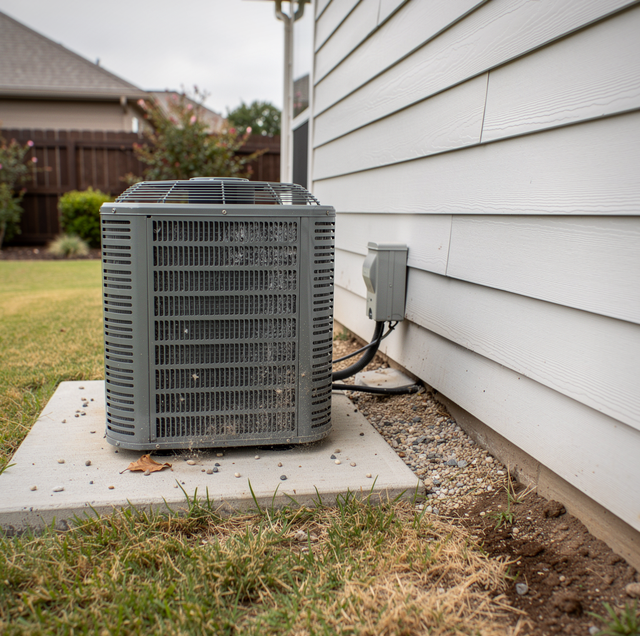
Open the spec sheets for three different outdoor units, and the compressor in each one responds to a cooling call differently. A single-stage compressor knows one setting: full output, or off. A two-stage compressor runs at roughly 65 to 70 percent of its capacity for most calls and steps up to 100 percent only when the load asks for it. A variable-speed compressor, driven by an inverter board, adjusts continuously across a much wider range, down to roughly a quarter to a third of capacity depending on the model, matching output to the load in small increments rather than jumping between one or two settings.
None of that shows up on a mild spring afternoon, when any of the three can satisfy the house quickly and shut off for a long stretch. It shows up across a cooling season that runs for months rather than weeks, where the compressor's design determines how it spends that time and what it costs. The sections below compare the three against exactly that: a long run of hot days, one after another, not a single afternoon.
How Each Type Spends a Long Cooling Day
A single-stage system has no lower gear, so every call it answers is the same call: full compressor speed, full condenser fan speed, until the thermostat is satisfied. On a hot afternoon, that means one long run rather than several short ones, which is how a single-stage system is meant to work. The complaint that shows up over a long summer is not the shape of any one cycle, but the total hours the compressor spends at full electrical draw, because full output is the only output it has.
A two-stage system spends most of a summer day on its low stage, stepping up only when outdoor temperature or indoor load exceeds what the low stage can handle. That low stage isn't a slower version of the same run; it's a separate, lower current draw the compressor was built to sustain for long stretches. A variable-speed system goes further and spends most hours between its extremes, settling at whatever output matches the house's heat gain at that hour, which on a long, steady-hot afternoon is often a single unbroken run somewhere in the middle of its range rather than a repeated on/off pattern at all.
Where oversizing turns into extra starts
A single-stage compressor's binary design is also why a sizing mismatch carries a real cost over a long cooling season. Because the compressor has only two states, any gap between its capacity and the day's actual load has nowhere to go: an oversized single-stage unit still runs at full output every time it starts, and it starts and stops rather than settling into a longer run. That short-cycling lands in the part-load hours, mornings, evenings, and the milder weeks at either end of the season, not on the hottest afternoons, when even excess capacity has real work to do. A cooling season that runs for months adds up more part-load hours than one that runs for a few weeks, and each one is spent starting the compressor against its own startup surge rather than carrying a longer run. Where a cooling season is short and mild, those same part-load hours are fewer to begin with, so an equivalent sizing gap has less time to add starts. Two-stage and variable-speed compressors meet those part-load hours at partial output rather than a full-power start, which keeps a comparable sizing gap from turning into as many extra starts over a long season.
Humidity Removal Depends on How Long the Coil Stays Wet
A coil pulls water from the air only once its surface temperature drops under the dew point of whatever air stream is moving across it, a state that takes a run of some length to reach and hold, not a quick one. A single-stage system that reaches setpoint quickly on a mild-load afternoon can end its run before the coil has been wet long enough to remove much moisture at all, even though the thermostat reads satisfied. On the hottest days of a long season, this matters less, because full-output runs on those days tend to last long enough regardless.
A two-stage or variable-speed system spends more of its runtime at partial capacity, so a given cooling output takes a longer run and more total wet-coil minutes per degree of temperature drop. Over a long, humid stretch that adds up: the same average cooling output leaves the coil wet for more of the season, without moving air any faster.
Ask to see the equipment's latent (moisture) capacity at your design conditions next to the load calculation's latent load, not just the tonnage. A system can match the sensible load and still fall short on moisture.
Cycling Behavior Differs by Design, Not by Fault
Each compressor type has a different normal cycling pattern, and comparing one type's normal pattern to another type's pattern can read a perfectly healthy system as faulty. A single-stage unit cycling off and on several times an hour on a mild day is doing what a single-stage unit does; the same pattern on a variable-speed system, which is built to hold a long, steady, lower-output run instead, points somewhere else. Working out whether a specific system's cycling pattern is normal for its stage type, or points to an install-specific fault, takes its own set of run-time measurements rather than a guess about equipment size.
Sizing Tolerance: How Much Room for Error Each Type Forgives
Manual S equipment selection carries a tolerance of roughly 15 percent above the Manual J load calculation, a step that guessing at tonnage from square footage alone skips. A single-stage system has the least room inside that tolerance to be wrong, because its only two states are full output and off; oversize it, and there is no lower setting to absorb the excess, so the system satisfies the thermostat faster than the coil can do its job on humidity, every time it runs. A two-stage system tolerates a modest oversizing error better, since its low stage can cover part of the oversized capacity, whereas a single-stage unit of the same tonnage would still run at full output regardless. A variable-speed system tolerates the largest sizing error of the three, precisely because it isn't choosing between two or three fixed outputs but instead slides to whatever output the load calls for, within its rated range.
None of that is a case for skipping the load calculation. An undersized system has its own set of problems that staging or modulation cannot buy back, chiefly a compressor running continuously against a load it cannot fully satisfy. Staging widens the margin for error; it doesn't remove the need to size the equipment correctly in the first place.
What Fails on Each Type, and What Repair Looks Like
A single-stage system's controls are the simplest of the three: a contactor, a run capacitor, a single-speed condenser fan motor, and a compressor with one set of start and run windings. Most of what stops a single-stage unit is a failed component in that short list, and a technician can usually confirm which one with a meter at the disconnect.
A two-stage system adds a staging relay or a dual-capacity valve inside the compressor itself, plus a control board that decides when to call for the second stage. A failure in that staging logic doesn't always take the whole unit down; a two-stage compressor stuck on low stage will still run, just without the extra capacity the hottest days need, which can look like an undersized system rather than a stuck stage.
A variable-speed system replaces most of that mechanical staging logic with an inverter drive board that converts household AC power to a variable-frequency output for the compressor motor. That board, along with a communication control system that ties the thermostat, indoor unit, and outdoor unit together, adds failure points that a single-stage system does not have, and diagnosing them requires a manufacturer-specific interface rather than a generic multimeter reading.
An inverter drive board keeps a high-voltage charge in its capacitors after the disconnect is pulled, and nothing on the outside shows it. Leave the panel and board to a licensed technician, who will first verify the discharge.
Side by Side Through a Long Cooling Season
| Single-Stage | Two-Stage | Variable-Speed | |
|---|---|---|---|
| Typical output range | Full output or off | ~65-70% low, 100% high | Roughly a quarter to a third up to 100%, continuous |
| Runtime pattern on hot days | One long full-output run | Mostly low stage, high stage on peak load | Steady mid-range run matched to load |
| Humidity control | Weakest on mild-load days | Better than single-stage | Best of the three on humid days |
| Room for sizing error | Least | Moderate | Most |
| Main failure points | Contactor, capacitor, fan motor | Staging relay/valve, control board | Inverter drive board, communicating controls |
Frequently Asked Questions
No. Staging is built into the compressor itself, which has two distinct mechanical capacities, not a feature added through the thermostat or control board afterward. Getting two-stage operation on a system installed as single-stage means replacing the outdoor unit, not upgrading a component inside it.
It depends on the brand. Some lines need their own communicating control to modulate at all; others modulate from a standard 24-volt thermostat using their own sensors. Check the model's installation manual before choosing the thermostat.
Often, yes. On low stage, the compressor runs unloaded and, on many models, the outdoor fan drops to a lower speed. Manufacturers that publish sound ratings commonly list a separate, lower figure for low-stage operation, so the model's spec sheet answers this directly.
Not always. The inverter drive board that controls the compressor's speed is a separate part from the compressor itself and can often be replaced on its own if the board fails, but the compressor windings test fine. A failure inside the compressor windings is a different repair, and because the compressor and its inverter are matched and tested as a set by the manufacturer, replacing just the compressor without also verifying the drive board is not always an option.
It carries more weight. A variable-speed blower is programmed to hold a target airflow at every step of its range, and against restrictive duct it ramps its motor harder to hold that target, which adds noise and power draw and can leave high stage short of the airflow its rated capacity assumes. Duct static measured at full blower speed indicates whether the system can reach that capacity at all.
On many models, yes. The outdoor fan stages along with the compressor rather than running at one fixed speed regardless of stage, because the condenser needs proportionally more airflow to reject heat when the compressor steps up to its high stage. A two-stage unit whose fan runs at only one speed while the compressor stages is a mismatch worth asking the installer about directly.
Get the load and duct static measured before choosing a stage type — a technician matches single-stage, two-stage, or variable-speed equipment to your home's load and ductwork. Fix My Air DFW serves Fort Worth and the DFW metro. TACLA33709C. Call (817) 439-9811.